
Timeline / The first self-winding watch
The first self-winding watch
Abraham-Louis Perrelet of Le Locle is credited with a pocket watch that wound itself as its owner walked.
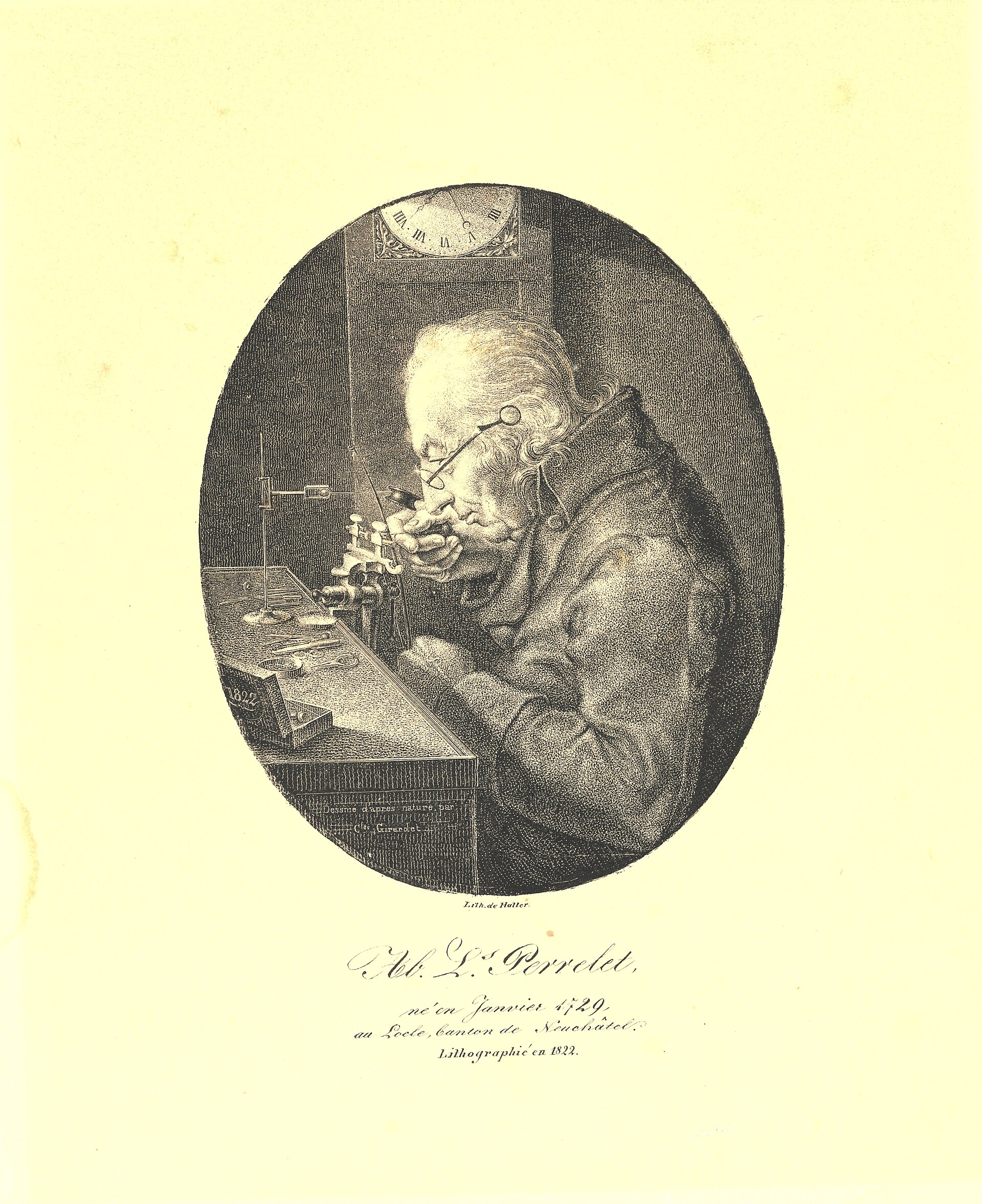

- The need
- A watch had to be wound every day with a key, and a forgotten winding meant a stopped watch.
- Made by
- Abraham-Louis Perrelet, a watchmaker of Le Locle in the Swiss Jura.
- What was new
- A swinging weight inside the watch that moved with the wearer’s steps and wound the mainspring as he walked.
- Worth knowing
- The Geneva Society of Arts reported that fifteen minutes of walking wound the watch for eight days. The principle only worked in a pocket, carried by someone on foot. Breguet took it up from about 1780 in his perpétuelles, and it returned in the wristwatch in 1923.
- Where it is now
- No watch firmly attributed to Perrelet survives.
Historian’s noteThe evidence for Perrelet is second-hand: a 1777 note by the naturalist Horace-Bénédict de Saussure naming him as the inventor. Hubert Sarton presented a self-winding design with a central weight to the Paris Academy of Sciences in December 1778, with drawings that survive, and Louis Recordon patented a self-winding watch in London in 1780. Some researchers credit Sarton. The modern Perrelet brand has no descent from him.
SourcesPerrelet
Suggest a correction
Thank you. Your note has reached the editor.