Timekeeping / Su Song’s clock tower
Su Song’s clock tower
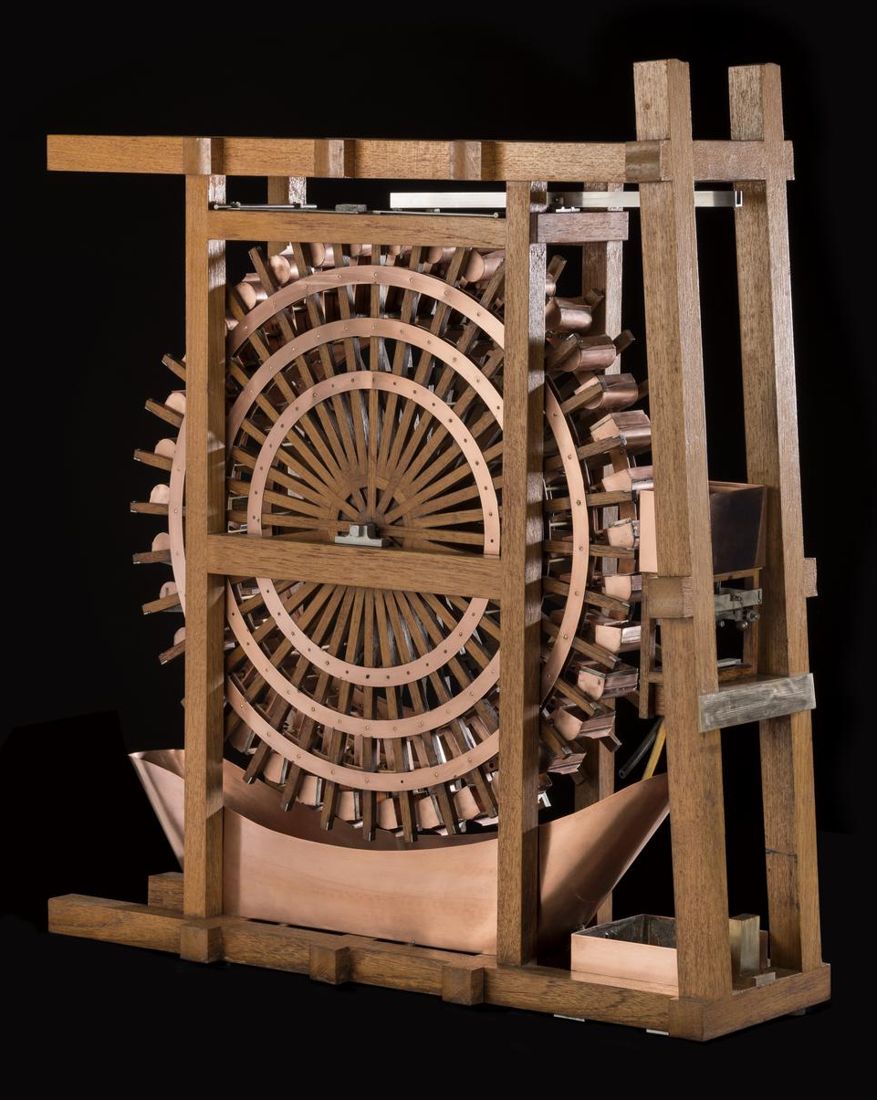
In Kaifeng a water wheel turns one scoop at a time, held and released by a weighing lever.
- The need
- In 1086 the emperor ordered Su Song to build an astronomical clock that would drive an armillary sphere, a celestial globe and hour-announcing figures at an even rate, day and night.
- How it worked
- Water from a tank kept at a constant level pours into the scoops on the rim of a great wheel. The wheel cannot turn freely: a lever with a counterweight, working like a steelyard balance, holds it. When the top scoop is full its weight tips the lever, the stop lifts, the wheel advances exactly one scoop, and the lever drops back and holds it again. The wheel therefore turns in equal steps at an even rate, and drives the sphere, the globe and the hour figures. A pilot model ran in 1088 and the full-size machinery was finished the same year; the bronze sphere and globe followed in 1090, and the book in 1094.
- What it changed
- Needham called this a “water-balance escapement” and the earliest known escapement: power released in equal, counted steps. The balance here is a weighing beam, not the oscillating balance wheel of a watch; that came with the European verge-and-foliot clocks and, in 1675, the balance spring. But the principle, let the drive advance one step at a time, is the same one every mechanical watch still uses.
- Where it is now
- The tower was wrecked when the Jin took Kaifeng in 1126. Su Song’s book survives in later copies, and modern reconstructions, such as the Science Museum’s 1965 model in London, are built from its drawings.
SourcesNeedham, Wang & Price, Heavenly Clockwork (1960); Needham, Science and Civilisation in China IV.2 (1965), pp. 446–465 · Science Museum Group, model 1965-8