Timekeeping / Al-Jazari’s elephant clock
Al-Jazari’s elephant clock
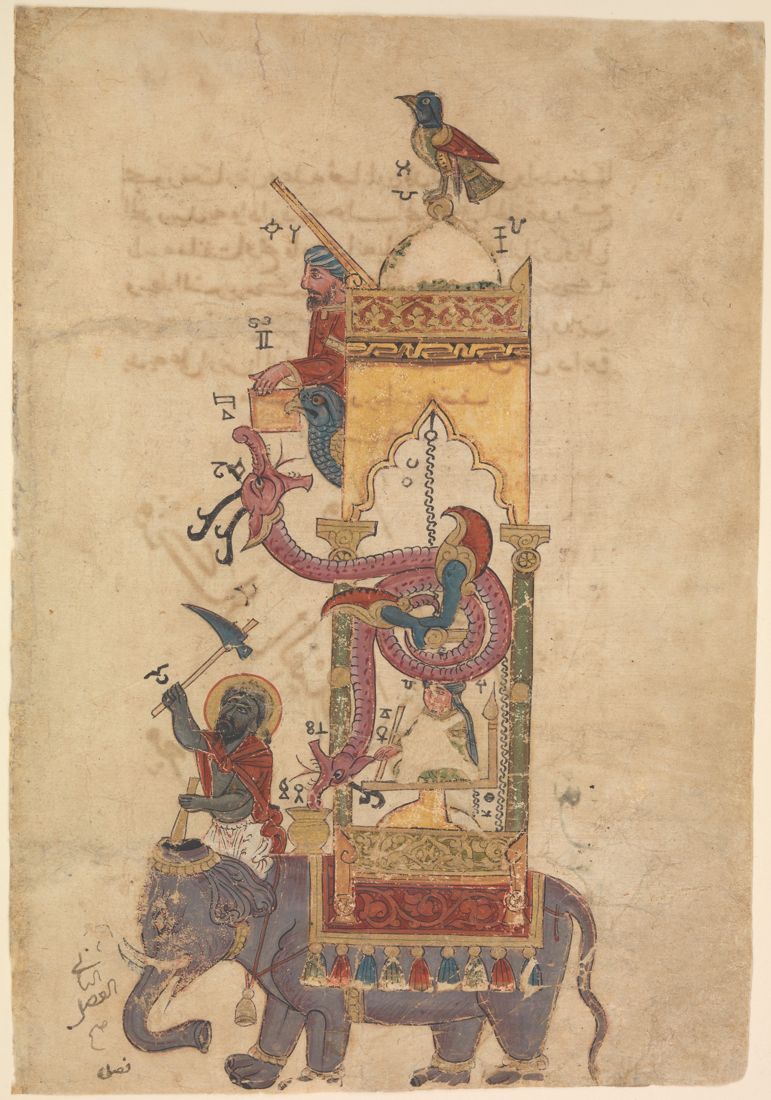
A 1315 copy of al-Jazari’s 1206 book: water, floats and falling balls drive an elephant clock.
- The need
- The courts of the Jazira, in what is now south-eastern Turkey, wanted clocks that performed: striking, moving figures, hours that changed with the season. Al-Jazari, engineer to the Artuqid rulers of Diyarbakır, finished his book of devices in 1204 or 1206 to record what he had built in twenty-five years.
- How it worked
- The elephant is a case. Inside it a perforated bowl floats on a tank of water and sinks at a set rate, taking half an hour. As it sinks it pulls cords that release a ball from the tower on top; the ball falls into a dragon’s jaws, the dragon tips and drops it on a cymbal, the mahout strikes, and the scribe’s pen moves on the dial. The bowl is hauled back up and the cycle begins again.
- What it changed
- The page shows the whole medieval Islamic toolkit of floats, siphons, tipping buckets and ball releases, a generation before Europe’s first mechanical escapements. The knowledge survived because the book was copied again and again.
- Where it is now
- The author’s text survives in a Topkapı manuscript of 1206. This painting comes from a copy made in Mamluk Syria in 1315, now dispersed between the Metropolitan Museum, the Freer Gallery and the Museum of Fine Arts, Boston.
SourcesThe Met, 57.51.23 · Hill, The Book of Knowledge of Ingenious Mechanical Devices (1974)