Timekeeping / Wells Cathedral clock
Wells Cathedral clock
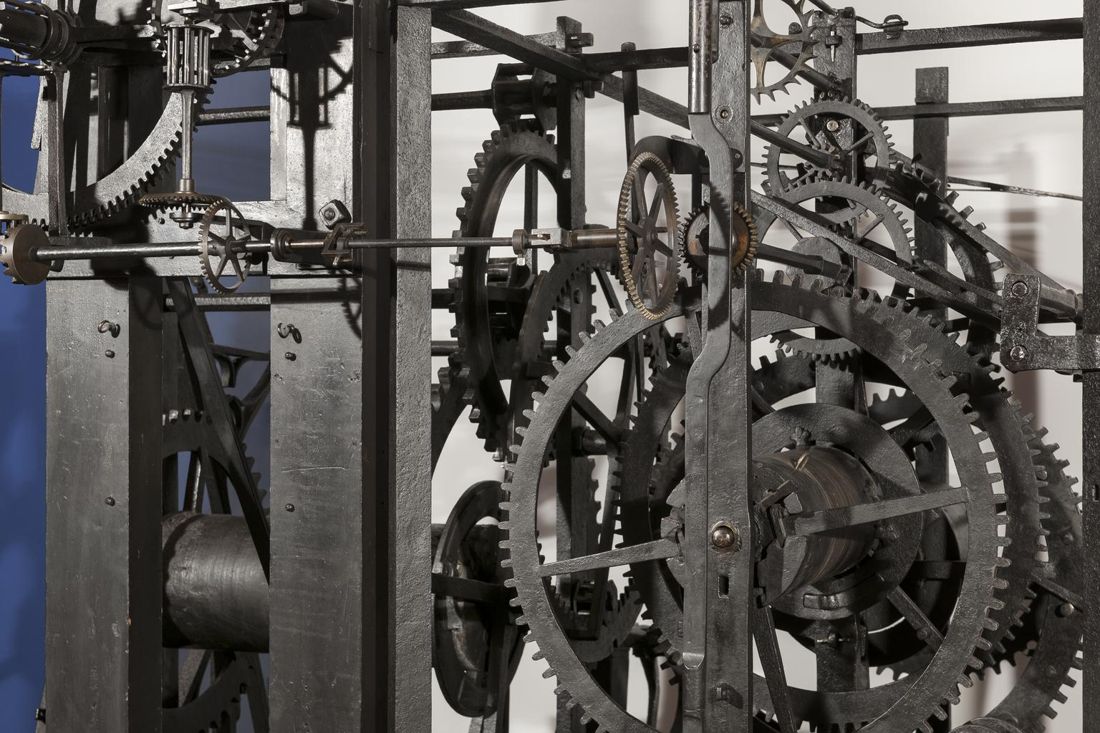
A falling weight, let out tick by tick by a verge and foliot, struck the hours. The movement has no dial.
- The need
- Monasteries and towns had to be woken and summoned at fixed hours through the night, in all weathers, when sundials and frozen water clocks failed. Makers were already trying in the 1270s; in 1283 the monks of Dunstable wrote that they had made a “horologium”.
- How it worked
- A weight on a rope turns a train of wheels. A crown wheel and a swinging bar, the verge and foliot, let the train advance one tooth at a time: tick, tock. The first clocks struck a bell and had no dial of their own; Wells drove a separate astronomical dial inside the cathedral, Salisbury’s clock never had one, and St Paul’s in London only added an outside dial in 1344.
- What it changed
- Equal hours struck in public replaced the seasonal hours of sundial and church; the town clock, not the sun, now set the working day. Everything in the Pocket watch and Wristwatch timelines starts from this escapement.
- Where it is now
- The movement is in the Science Museum, London, on loan from the Dean and Chapter of Wells; the astronomical dial it once drove is still in the cathedral, now worked by a modern movement. Salisbury Cathedral’s clock, recorded in 1386, is of the same type and still runs.
SourcesScience Museum Group, 1884-77 · Annales de Dunstaplia 1283, ed. Luard, Annales Monastici III, p. 296 · Salisbury Cathedral, the clock · Dohrn-van Rossum, History of the Hour (1996)