Timekeeping / The Burgundy clock
The Burgundy clock
The oldest surviving clock driven by a coiled spring instead of a hanging weight, so it could be carried.
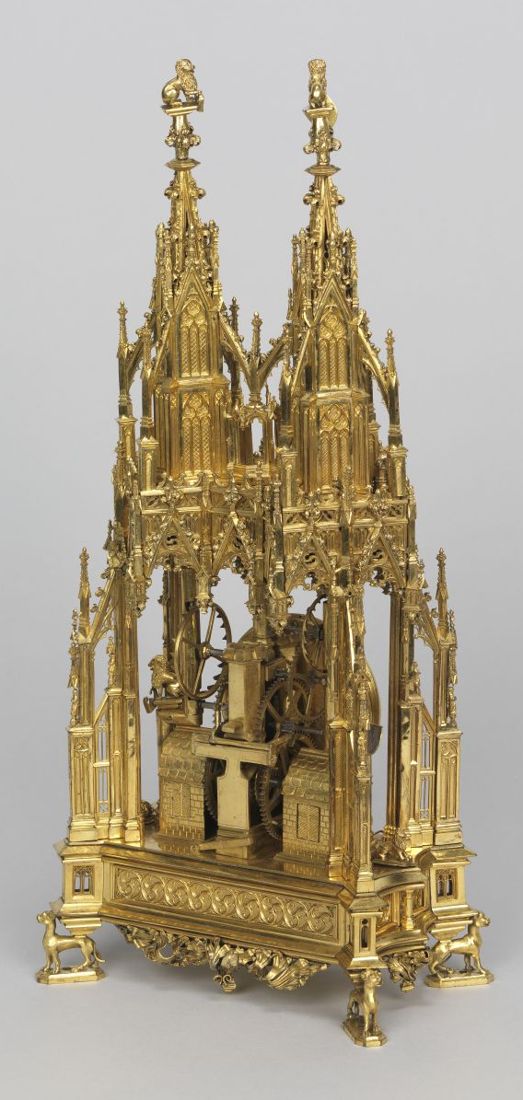
- The need
- A tower clock is driven by a weight on a rope, and a weight has to hang still: the clock cannot move. Princes wanted clocks that could travel with the court, from castle to castle. A wound steel spring stores the same energy in a box small enough to lift.
- How it worked
- Inside the case a steel ribbon is wound into a tight coil. As it unwinds it turns the wheels, doing the job of the falling weight. There is one problem: a spring pulls hard when fully wound and weakly as it runs down, so the clock would race and then lag. The makers solved it with a cone, the fusee: a cord from the spring drum winds around the cone, pulling on its narrow end while the spring is strong and on its wide end as it weakens, so the force reaching the wheels stays even. A single hand goes round the dial once in twelve hours.
- What it changed
- This is the ancestor of every portable clock and, made smaller, of the watch itself. Within a century makers in Nuremberg and Augsburg had shrunk the spring and wheels into a drum that fitted the hand. The Pocket watch timeline begins there, with the first dated watch of 1530.
- Where it is now
- Germanisches Nationalmuseum, Nuremberg. The clock has been known only since 1835 and its date has been argued over ever since; “around 1430” is the museum’s own dating.
SourcesGermanisches Nationalmuseum, HG 9771 · GNM provenance record · Zech, “Ein neuer Blick auf die Burgunderuhr”, DGC Jahresschrift 57 (2019)