Timeline / The first split-seconds chronograph
The first split-seconds chronograph
First
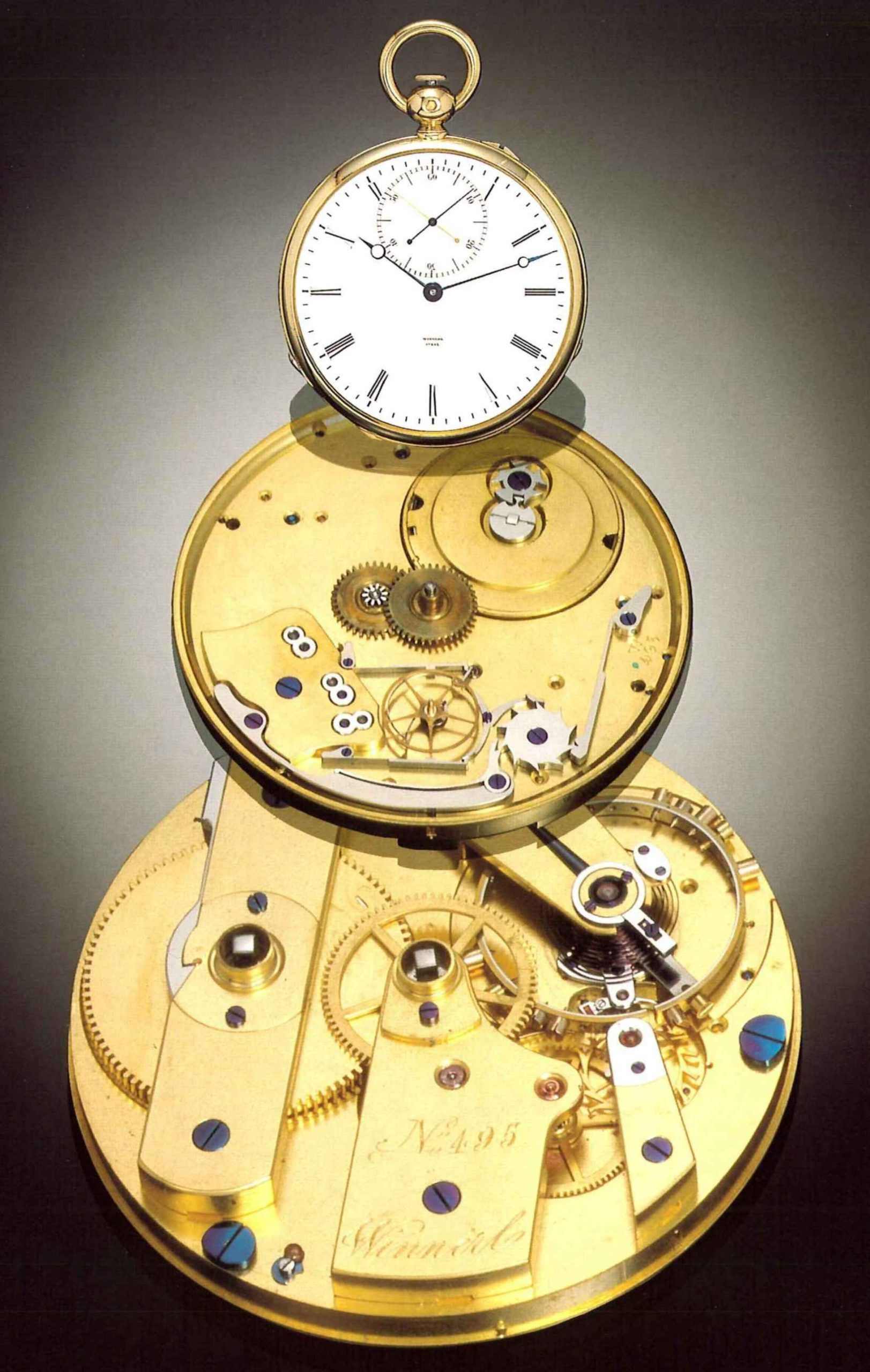
By 1838 Joseph Thaddäus Winnerl in Paris had made a seconds hand that could be stopped while a second one ran on, and caught up again at a touch. This watch, his No. 495, is from about 1840.
- The need
- A single seconds hand can only stop once. To read a lap or a second runner without losing the main time, an observer needs a second hand that can be held while the first keeps going.
- Made by
- Joseph Thaddäus Winnerl, a watchmaker who came to Paris in 1829 and had his own workshop there from about 1832.
- What was new
- Two seconds hands one above the other on a small dial. A push piece in the pendant stops one of them while the other runs on; released, it jumps back to join the running hand. The gilt bar calibre has a straight-line lever escapement, a cut bimetallic balance and a Breguet balance spring, in a 50 mm four-body case.
- Worth knowing
- The mechanism was described in the Bulletin of the Société d’encouragement pour l’industrie nationale in 1843. Return to zero came with Adolphe Nicole’s patent of 1844. The first split-seconds wristwatch followed in 1923.
- Where it is now
- Sold at Antiquorum, Geneva, on 14 November 1993 (lot 218); the present owner is not published.
Historian’s noteA. Lange & Söhne and the auction catalogues date Winnerl’s first split-seconds mechanism to 1838, improved in 1840. The watch shown, his No. 495, is an example of about 1840. Sotheby’s calls Winnerl’s 1838 design “a form of” the split-seconds and names Thomas Prest among the early makers.
SourcesA. Lange & Söhne, The development of the rattrapante function · Antiquorum, 14 November 1993, lot 218 · Sotheby’s, Achille-Hubert Benoît split-seconds, about 1840 · Antiquorum, 16 November 2003, lot 88
Suggest a correction