
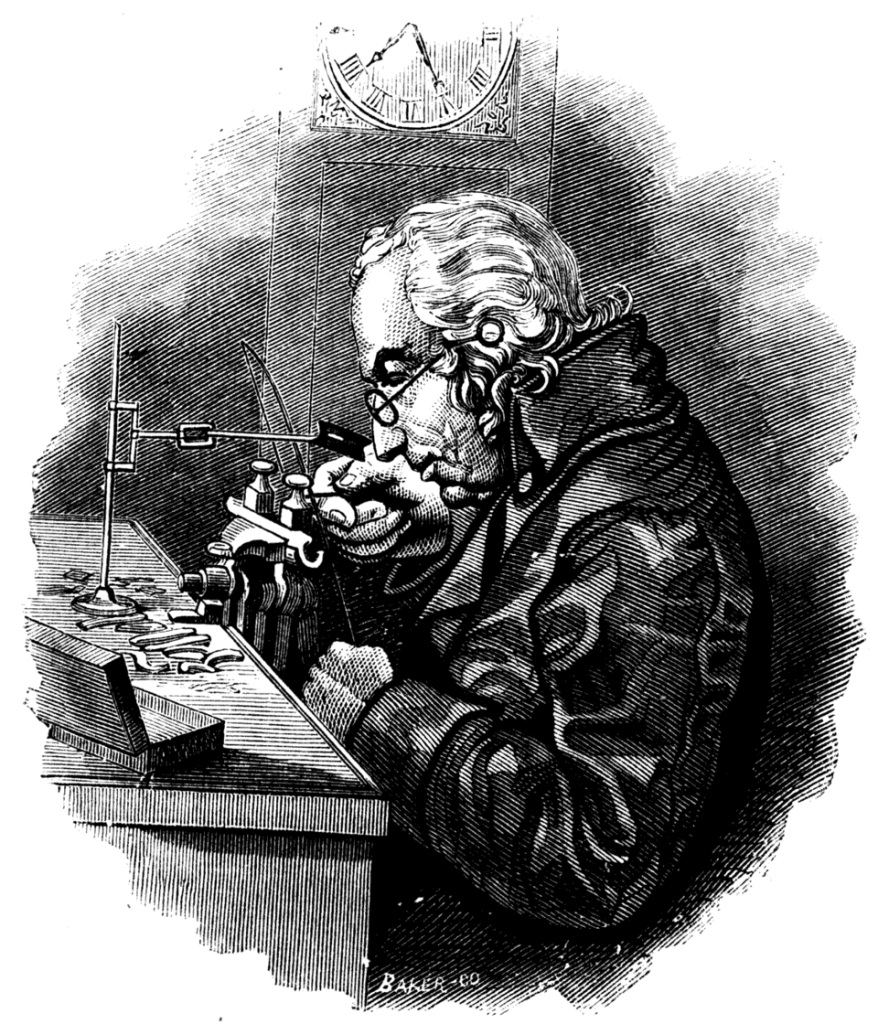
Beginnings
Perrelet was born in Le Locle in the Neuchâtel mountains and, by the account his family gave in 1863, served an apprenticeship of about fifteen days with a watchmaker called Prince before deciding he could teach himself. He stayed in Le Locle for the rest of a very long life, and the other masters of the valley are said to have settled their hard cases by going “to see the old Perrelet”.
What he changed
On 11 June 1777 the Société des Arts in Geneva recorded that a watchmaker named Perrelet had made “a watch of such a construction that it is wound up in the pocket of the person who carries it”; the naturalist Horace-Bénédict de Saussure, who examined it, noted that a quarter of an hour of walking wound it for eight days. That minute is the earliest documentary evidence of a self-winding watch, and it is on the pre-wristwatch timeline. His tools for planting and rounding wheels, and his work on cylinder and duplex escapements, were the stock of the Le Locle trade for a generation; the pedometer of about 1780 that the modern Perrelet company credits to him rests on the house’s own account.
Why it matters now
Every automatic watch made today winds itself as his did, from the movement of the wearer; the rotor that does it was perfected by others, but the idea that a watch could feed on its owner’s walking was tested first in Le Locle. Breguet bought Perrelet’s watches around 1780 and built his own perpétuelles from them.
Worth knowingThe Geneva minute carefully avoids the word inventor; only de Saussure’s private diary uses it.
Historian’s noteTwo of the stories told about Perrelet are weaker than the 1777 minute. The claim that he invented the rotor is contested by the historian Richard Watkins, who traces the rotor to Hubert Sarton of Liège in 1778; Perrelet’s documented watch used a side weight. And “teacher of Breguet” is house tradition: Breguet trained at Versailles and the two men’s link is commercial, not that of master and pupil.
SourcesWatkins, The Origins of Self-Winding Watches · Perrelet · WorldTempus