
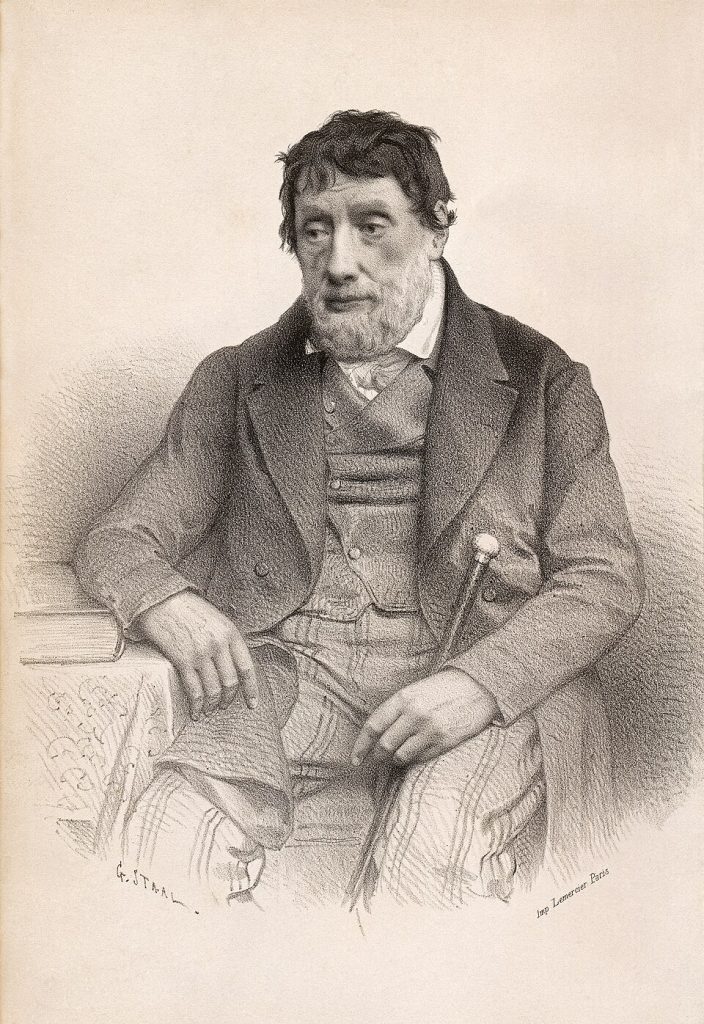
Beginnings
Moinet was born in Bourges in 1768, the son of domestic servants, and read law there until the Revolution closed the schools. He went to Rome and Florence to study drawing, sculpture and gem-engraving, came to Paris in 1794 as a professor at the Académie des Beaux-Arts in the Louvre, and only then gave himself to clocks. For some years he was Breguet’s secretary and friend, and he designed clocks for the bronze-founder Thomire that went to Napoleon, Jefferson and the Tsar.
What he changed
In 1815 he began, and in 1816 finished, a compteur de tierces: a counter beating 216,000 times an hour, thirty a second, that could be started, stopped and reset to time the passage of stars across a telescope’s reticle to a sixtieth of a second. It is the earliest chronograph known, and it sits at the start of the chronograph story on this site. In 1848 he published the Nouveau traité général d’horlogerie, twenty years in the writing, which taught the next generation.
Why it matters now
For two centuries the first chronograph was Rieussec’s inking machine of 1821. Then Moinet’s counter surfaced at auction in 2012, was restored and dated from its own hallmarks, and the history moved back five years. It is the best modern example of why this site prefers objects to legends.
Worth knowingMoinet wrote in his own treatise that the counter “worked very well” in giving him exact intervals between the reticle lines; he built it for his astronomy, not for sale.
Historian’s noteHis birth date is given as 21 March 1768 in most modern sources and 7 December 1768 in the Bourges parish-based account; only the year is used here. The modern Louis Moinet company, founded in 2004, carries his name but has no continuity with his workshop, and its Guinness certificates of 2016 and 2020 are its own initiative.
SourcesEncyclopédie de Bourges · FHH · Revolution