
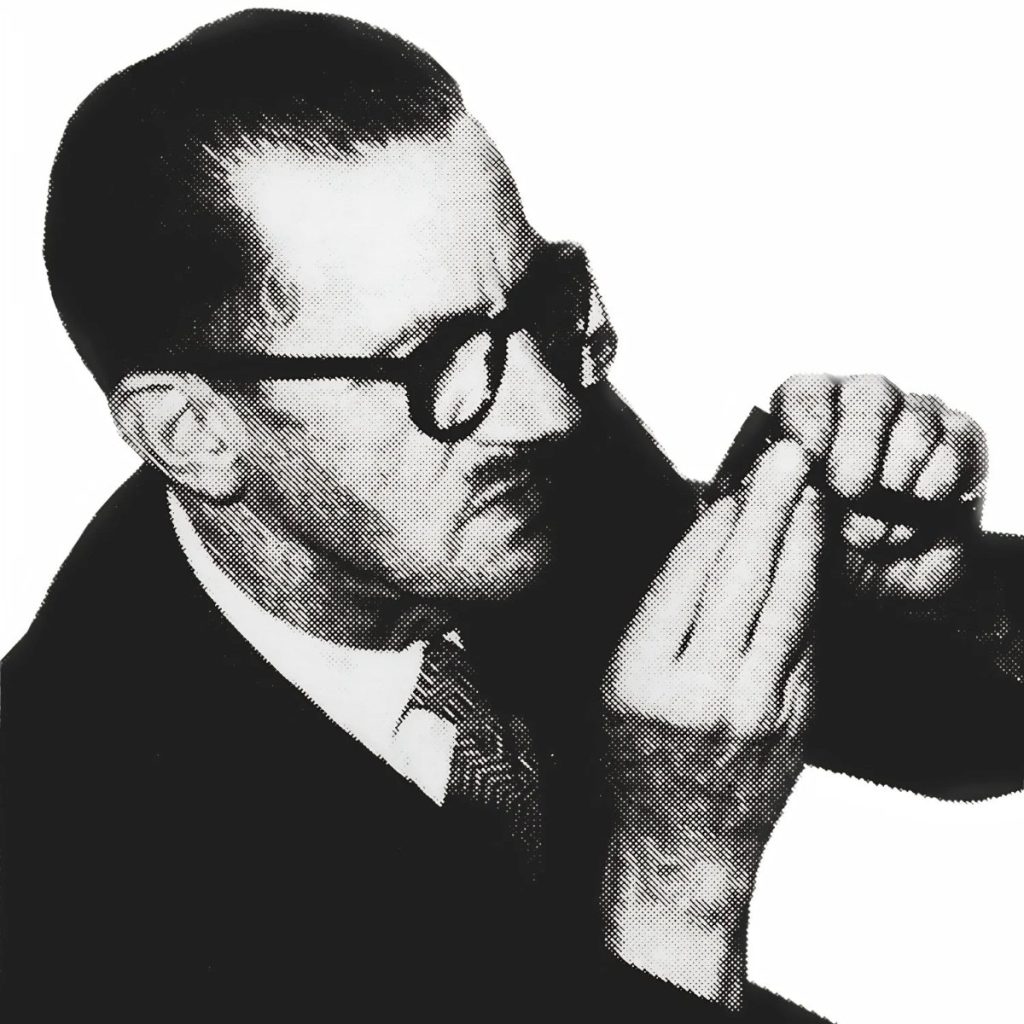
Beginnings
Harwood was born in Bolton in 1893, apprenticed as a watch repairer, worked for Hirst Brothers in Oldham and served as an armoury sergeant in the war. Afterwards he set up on the Isle of Man, where the repair bench taught him the problem: dust and damp got in through the winding stem, and the watches that came to him were dirty inside. A wristwatch with no stem would need to wind itself.
What he changed
With his partner Harry Cutts he applied for a Swiss patent on 16 October 1923, granted as no. 106583 on 1 September 1924: a weight inside the case swung through about 180 degrees against buffer springs and wound the mainspring, and the hands were set by turning the bezel, so the case had no crown at all. He showed it at the Basel Fair in 1926, Fortis of Grenchen put it into production that year and A. Schild made the movements; Blancpain licensed it for France. The Harwood Self-Winding Watch Company was founded in London in November 1928 and the watches sold at Selfridges. About 30,000 were made before the slump; the company was wound up in 1932. It is on the timeline as the first self-winding wristwatch.
Why it matters now
Rolex’s Perpetual of 1931 replaced his bumper with a rotor that turns all the way round, and the automatic watch went that way; but Rolex printed a correction in 1956 acknowledging that Harwood had developed the self-winding wristwatch and Fortis had made it first. The British Horological Institute gave him its gold medal in 1957.
Worth knowingThe story that a child on a seesaw gave him the idea is his own, told late in life, and is repeated here as that.
Historian’s noteSources differ on the small facts: the company’s failure in 1931 or 1932, his death in 1964 or 1965, his arrival on the Isle of Man in 1919 or 1922. The patent dates are from the patent itself.
SourcesBoettcher, Fortis and Harwood · Fortis · Google Patents CH106583