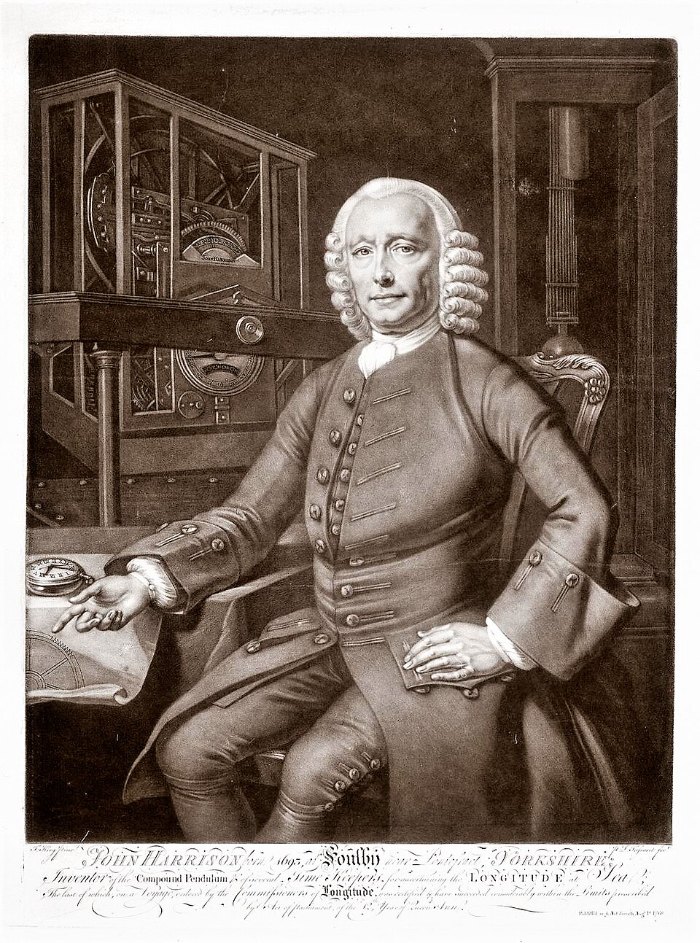
Beginnings
1693Harrison was born in Yorkshire in 1693.
He grew up at Barrow-upon-Humber in Lincolnshire, where his father was a carpenter. He learned the trade and taught himself clockmaking.
1713He built his first clock, in wood, in 1713.
Mid-1720sBy the mid-1720s his regulators at Barrow were keeping time to a second a month, with two inventions of his own. These were the gridiron pendulum, whose brass and steel rods cancelled each other’s expansion, and the grasshopper escapement, which needed no oil.
What he changed
The challengeThe Longitude Act of 1714 offered £20,000 for a way of finding longitude at sea to half a degree.
H1Harrison answered with clocks. H1, built from 1730 to 1735, went to Lisbon and back in 1736 and earned him the Board’s first grant.
H2 and H3H2 and H3 took the next twenty-four years.
Small, fast balanceThen he changed course. A pocket watch made to his design by John Jefferys in 1753 showed that a small, fast balance could do what big clocks could not.
H4H4, finished in 1759, is a watch five inches across. It lost five seconds on the voyage to Jamaica in 1761–62 and was within the Act’s limit again on the Barbados trial of 1764. Larcum Kendall’s copy, K1, sailed with Cook.
The paymentsThe Board paid £10,000 in 1765 after Harrison disclosed the construction, and Parliament voted a further £8,750 in 1773 after the King took an interest.
All five surviveAll five timekeepers survive, four of them at Greenwich.
Why it matters now
Precision instrumentH4 is the point at which the watch became a precision instrument, and the whole pursuit of precision on this site runs from it.
Marine chronometerThe marine chronometer that followed, perfected by Arnold and Earnshaw, kept every navy and merchant fleet on course until satellites did.
Worth knowingThe Royal Society gave him its Copley Medal in 1749, ten years before H4 existed, for the pendulum and escapement alone.
Historian’s noteHarrison never “won the Longitude Prize”. No one did. He received grants from the Board over forty years, £10,000 in 1765 and £8,750 from Parliament in 1773, about £23,000 in all. The 1753 watch was made by Jefferys to Harrison’s design. H4 is Harrison’s own. His birth date is 24 March in the old calendar, 3 April in the new.
SourcesRoyal Museums Greenwich, Longitude found · Royal Museums Greenwich, H4 · Science Museum Group · Science Museum, the King portrait