Timeline / The Semper Opera five-minute clock
The Semper Opera five-minute clock
Moment
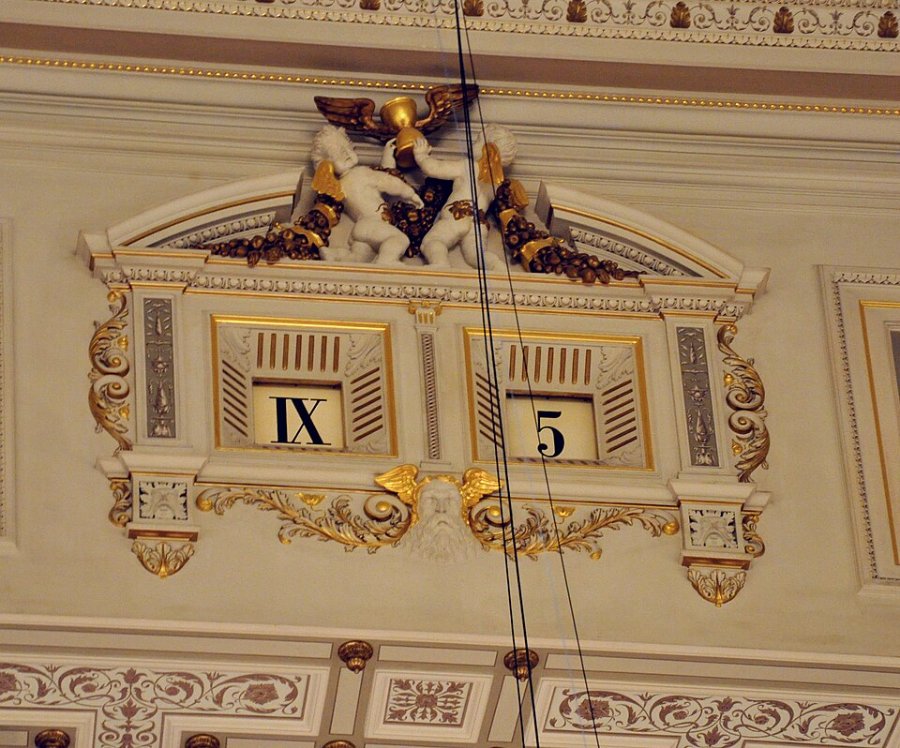
On 12 April 1841 the Dresden opera house opened with a clock above the stage that showed the time in numerals, hours on the left and five-minute steps on the right: the digital display that the Lange 1’s big date would quote 153 years later.

- The need
- Gottfried Semper’s opera house needed a clock the whole auditorium could read in the half-dark, without hands too small to see from the gallery.
- Made by
- Johann Christian Friedrich Gutkaes, clockmaker to the Saxon court, with his partner and future son-in-law Ferdinand Adolph Lange. Commissioned in 1838, started with the house on 12 April 1841.
- What was new
- Two cloth-covered drums about 160 cm across, with numerals about 40 cm high, showing through two apertures: hours I to XII on the left, minutes 5 to 55 on the right, advancing silently every five minutes. On the hour the right-hand aperture stayed blank.
- Worth knowing
- The clock was destroyed with the house in 1869 and rebuilt by Gutkaes’s apprentice Ludwig Teubner; destroyed again on 13 February 1945 and replaced with an electrically driven clock for the reopening of 13 February 1985. Teubner’s 1:10 model of 1896 is in the Mathematisch-Physikalischer Salon in Dresden.
- Where it is now
- Semperoper, Dresden, above the stage; the 1896 model in the Mathematisch-Physikalischer Salon, Staatliche Kunstsammlungen Dresden.
Historian’s noteThe Semperoper’s own account names Gutkaes as the maker; A. Lange & Söhne says Lange “participated”. The link to the big date of 1994 is a deliberate quotation by the modern house, down to the blank left-hand window for the first nine days of the month.
SourcesSemperoper, 180 years of the clock (PDF) · A. Lange & Söhne, The time in five-minute increments · Staatliche Kunstsammlungen Dresden, the 1896 model
Suggest a correction