
Beginnings
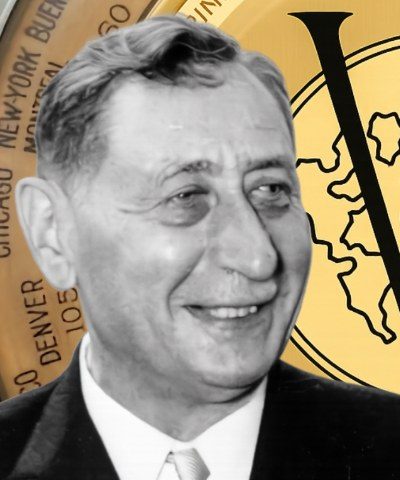
Cottier was born in Carouge, outside Geneva, in 1894, the son of the watchmaker Emmanuel Cottier, who in 1885 had published a design for a watch showing the time in every city at once. Louis entered the Geneva school of watchmaking in 1908 and worked in the city’s factories until 1931, when he set up alone in the back room of his wife’s stationery shop in Carouge, and later at 20 rue Ancienne.
What he changed
In 1931 he perfected the heures universelles: a dial with the hours of the twenty-four zones on a rotating ring, the names of their cities around the edge and local time in the middle, so that one glance gave the time everywhere. The first was sold through a Paris jeweller as a pocket watch; from 1937 Patek Philippe put the mechanism into wristwatches, and the Patek Philippe world time is on the timeline. Over thirty years he supplied some 380 movements to Patek Philippe alone, and others to Vacheron Constantin, Rolex, Agassiz and Movado; in the 1950s he added a second crown to turn the city ring, which is how the complication is still made.
Why it matters now
The world-time watch is one of the few complications that is one man’s design, and the ring of cities on every modern one is his. His papers are now in the Musée d’art et d’histoire in Geneva, being digitised.
Worth knowingIn 1945 and 1946 the Agassiz company had him make world-time watches for Truman, Churchill, de Gaulle and Stalin, and a small clock for Eleanor Roosevelt.
Historian’s noteCottier is often called the inventor of the world-time watch. His father’s published concept of 1885 came first; Louis made it work with a rotating ring, which is the form that survived. His family states that he registered no patents; the patent numbers that circulate for his later designs could not be verified here.
SourcesSJX · Collectability · Europa Star