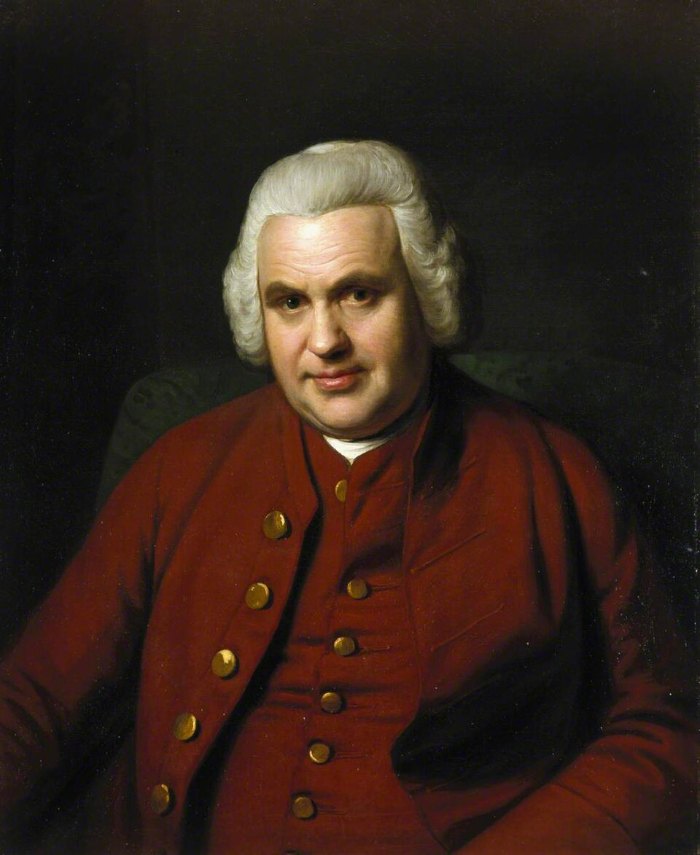
Beginnings
ExeterMudge was born in Exeter, the son of a clergyman and schoolmaster.
1731In 1731 he was bound apprentice in London to George Graham, the finest maker of his day.
1738He was free of the Clockmakers’ Company in 1738.
c. 1748He set up in Fleet Street about 1748.
1760sFrom the 1760s he worked in partnership with William Dutton.
1771In 1771 he left London for Plymouth to work on marine timekeepers.
1776In 1776 he was appointed Watchmaker to George III.
What he changed
Lever escapementAbout 1754 Mudge fitted an experimental timekeeper with an escapement. In it, a separate lever carries the impulse from the escape wheel to the balance and then lets the balance swing free. The detached lever was better than the verge and the cylinder in every way that matters.
Earliest known leverThe gold watch he finished in 1770 is the earliest lever watch known. It was bought by George III for Queen Charlotte and is still in the Royal Collection.
Marine timekeepersHe built three marine timekeepers between 1771 and 1779. The first was trialled at Greenwich and judged by Maskelyne “greatly superior” to any he had tested.
Commons grantAfter a long quarrel with the Board of Longitude, a Commons committee voted him a grant in 1793.
Why it matters now
Nearly forgottenMudge made very few lever watches, and the escapement was nearly forgotten.
Taken up by othersIt was English makers around 1800, then the Swiss, who made it universal.
Swiss leverBut the arrangement in nearly every mechanical watch made today, the Swiss lever, is his idea with the geometry tidied. The precision story on this site turns on it.
Worth knowingHe made Samuel Johnson’s first watch, in 1768.
Historian’s noteHis birth is given as 1715 or 1716 in the Oxford Dictionary of National Biography. It is given as September 1717 in the older Dictionary of National Biography. This page uses “about 1715”. The 1793 grant is reported as £2,500 by the DNB and £3,000 by the British Museum. The Count Brühl who championed him was Hans Moritz von Brühl, the Saxon envoy in London, not the Dresden minister. Mudge’s own sea clocks used a constant-force escapement, not the lever.
SourcesRoyal Collection Trust, Queen Charlotte’s lever watch · British Museum, marine timekeeper No. 1 · Science Museum Group · Dictionary of National Biography, 1894