The first pocket watch
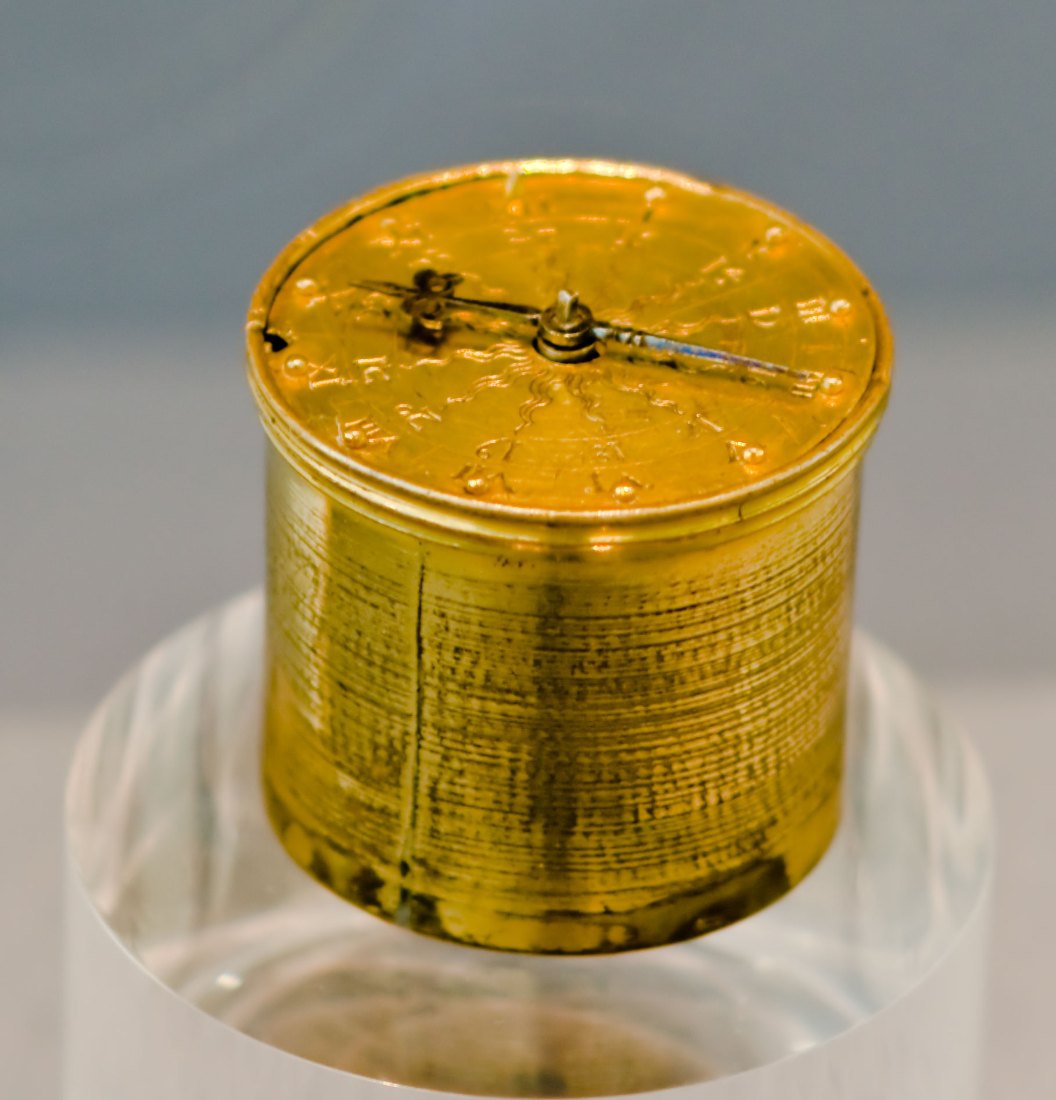
Around 1510 the Nuremberg locksmith Peter Henlein was making some of the first clocks small enough to carry in a purse. This drum engraved with his name and the year 1510 has long been known as the first pocket watch.

- The need
- A clock driven by a hanging weight has to stand still. Once makers learned to drive the wheels with a coiled steel spring, as in the Burgundy clock of about 1430, a clock could be made small enough to travel with its owner. In Nuremberg the locksmiths, who already made iron clocks, took this furthest.
- Made by
- Attributed to Peter Henlein (about 1485–1542), master locksmith of Nuremberg from 1509.
- What was new
- A timekeeper carried on the person. The movement is iron, driven by a spring instead of a weight, with one hand that shows the hours. In 1511 the scholar Johannes Cochlaeus described watches of this kind: Henlein made, out of a little iron, clocks of many wheels that ran and struck for forty hours without a weight, even when carried on the chest or in a purse.
- Worth knowing
- In 1524 the Nuremberg council paid Henlein 15 gulden for a gilded musk apple with a timepiece inside. His fame as the inventor of the watch grew in the nineteenth century: a memorial in the Walhalla (1842), a monument in Glashütte (1903) and the Henlein fountain in Nuremberg (1905).
- Where it is now
- Germanisches Nationalmuseum, Nuremberg (WI1265), bought in 1897.
Historian’s noteThe written record is firm. Cochlaeus saw Henlein’s portable watches in 1511, and the council bought one in 1524. The watch itself is not. The museum’s own study of 2013–14 used raking light and computed tomography. It found that the case is of a sixteenth-century type. But the movement, it found, was put together in the nineteenth century from old and new parts, and the signature was cut over older scratches. The museum now dates the watch to about 1530–80 and gives it to an unknown South German maker. A museum guide of 1930 had already called the signature a forgery. A gilt pomander watch in private hands, dated 1505 and also claimed for Henlein, has not been accepted by any museum. The earliest watch that carries a year on its own case is the Melanchthon watch of 1530, the next record on this timeline.
SourcesGermanisches Nationalmuseum, Dosenuhr, sogenannte Henlein-Uhr · GNM, The so-called Henlein pocket watch · Neue Deutsche Biographie 8 (1969) · Eser (ed.), Die älteste Taschenuhr der Welt? (GNM 2014) · Oestmann, Antiquarian Horology 39 (2018)
Suggest a correction