
Timeline / The first reversible wristwatch
The first reversible wristwatch
First
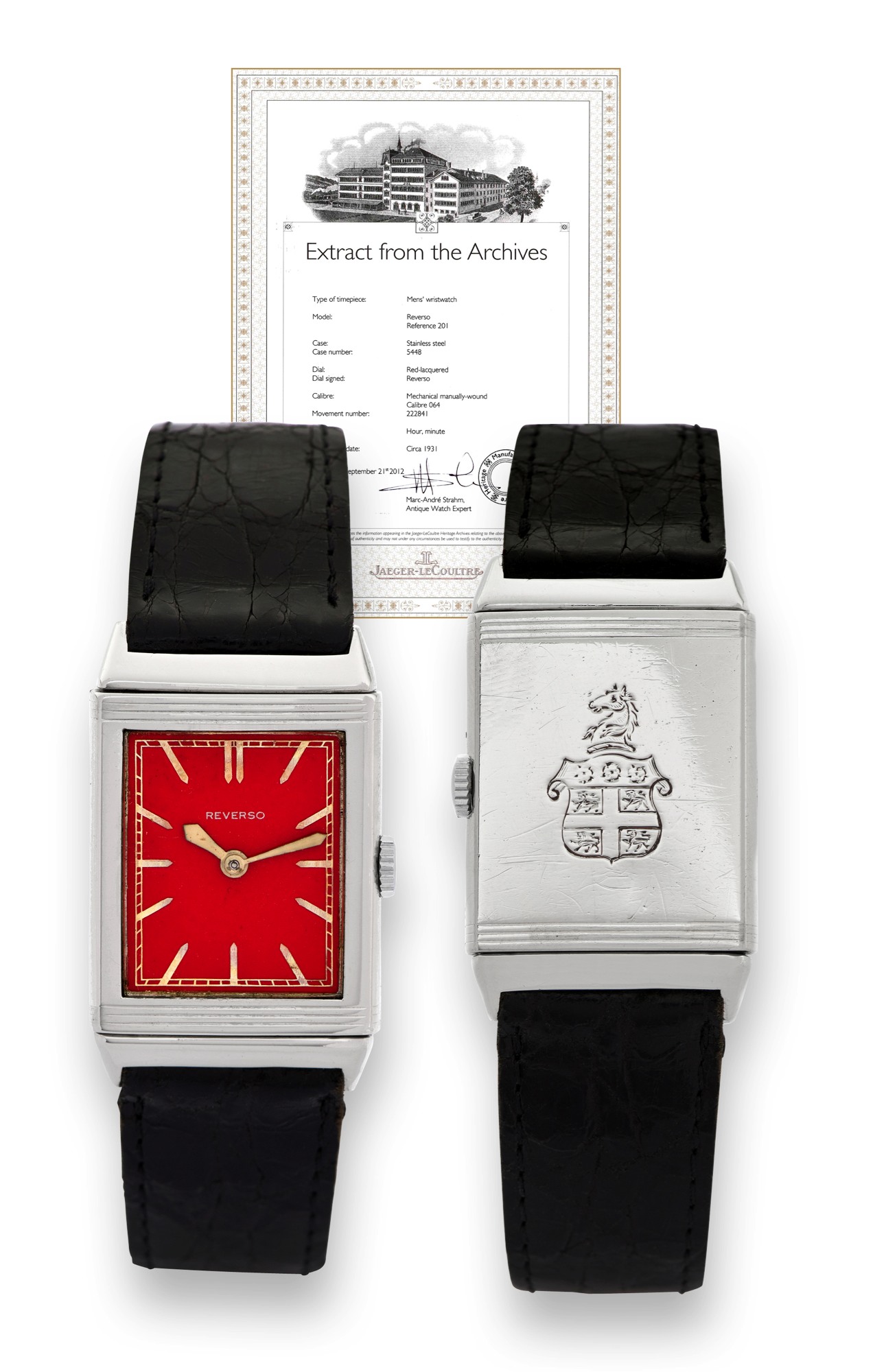
A watch whose case slides and flips over to turn a steel back to the world, patented on 4 March 1931 and made for polo players.
- The need
- British officers playing polo in India kept smashing their watch glasses. In the winter of 1930–31 one of them challenged the Swiss businessman César de Trey to make a watch that could survive a match.
- Made by
- The case was invented by the French engineer René-Alfred Chauvot, who filed the patent in Paris on 4 March 1931 and sold it to de Trey that July. LeCoultre & Cie of Le Sentier supplied the movements; the cases were made by Wenger. The name Jaeger-LeCoultre came only in 1937.
- What was new
- A rectangular case that slides along rails in its carrier and turns right over, so a solid steel back faces outward while the dial is safe underneath. The first pieces used Tavannes movements; LeCoultre’s own calibre 410 arrived in 1933.
- Worth knowing
- The flat steel back became a canvas for engraving and enamel, which is why so many early Reversos carry monograms, crests and portraits. The design has never gone out of production.
- Where it is now
- Early examples are in Jaeger-LeCoultre’s heritage collection at Le Sentier and come up regularly at auction.
Historian’s noteThe Universal Genève Cabriolet is sometimes dated 1929 and offered as an earlier reversible watch; Universal’s own history dates it to 1933, after the Reverso patent.
SourcesFrench patent FR712868 · Jaeger-LeCoultre
Suggest a correction