Timekeeping / The water clock
The water clock
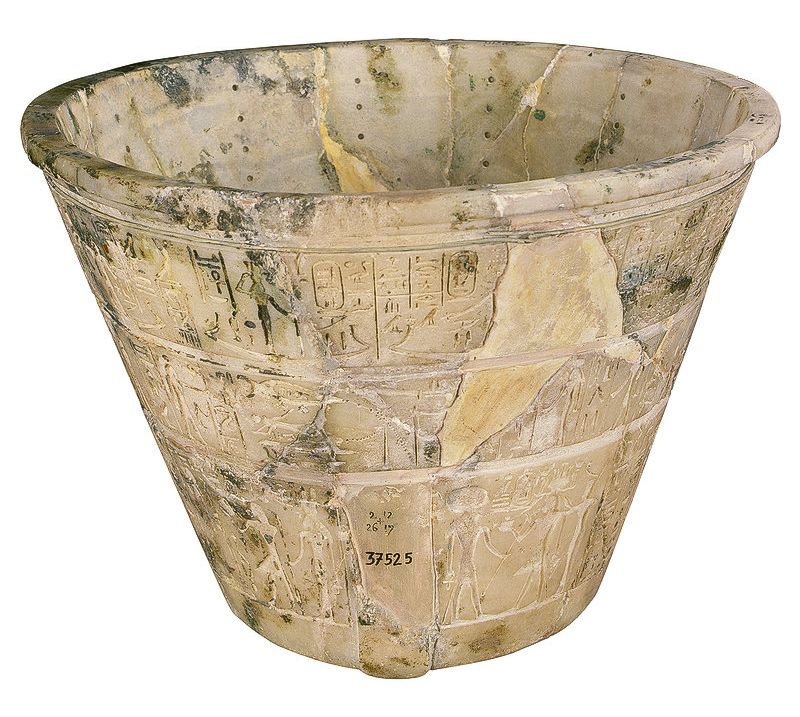
Water drains from a stone bowl; twelve scales inside, one per month, give the hours of the night.
- The need
- A sundial is useless at night, yet temple rites and the night watches had to be timed. About 1500 BC an official named Amenemhet recorded in his tomb that he had built an instrument because the night’s length increases and decreases from month to month.
- How it worked
- The clock is a wide bowl with a tiny outflow near the bottom. Filled at sunset, it drains slowly through the night; the water level is read against columns of marks inside, each column labelled with a month, the longest for the shortest night. The sides slope outward so that the level drops at a more even pace as the flow slows; it was only roughly right.
- What it changed
- The oldest surviving water clock and the model for Egyptian, Greek and Roman outflow clocks for the next thousand years. Babylonian scholars used the same idea in reverse, weighing the water that ran out during a watch to measure how long day and night were.
- Where it is now
- Found at Karnak in 1904; Egyptian Museum, Cairo (JE 37525), now displayed at the National Museum of Egyptian Civilization, Cairo.
SourcesSchomberg, “The Karnak Clepsydra and its Successors” (Edition Topoi 2018) · McMaster AEA, WCO 1 · NMEC, Clepsydra