Timekeeping / Why 60 minutes
Why 60 minutes
Scribes counted in sixties. Through Greek astronomy, the habit survives in our minutes and seconds.
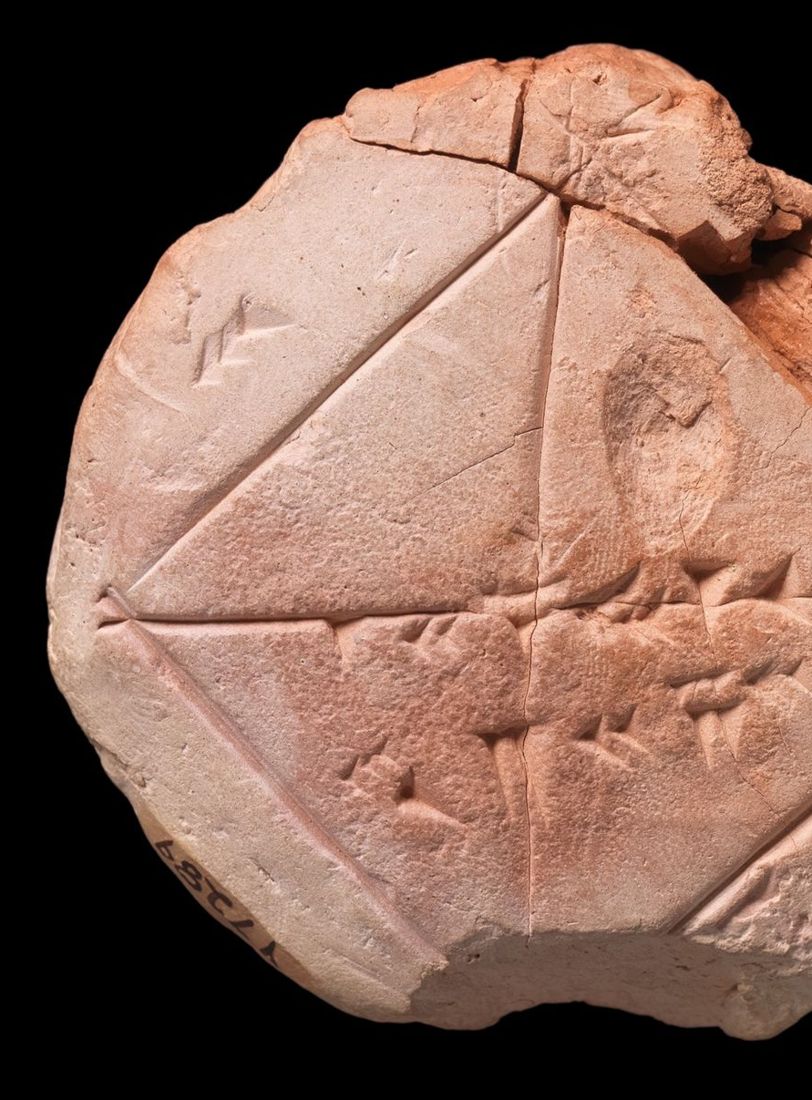
- The need
- Mesopotamian scribes needed to divide grain, land and silver without messy fractions. Sixty was the answer: it splits evenly into halves, thirds, quarters, fifths, sixths, tenths, twelfths and more. Base-60 counting is already on the first tablets from Uruk.
- How it worked
- Numbers were written in a place-value system of sixties, much as ours uses tens. Fractions were written the same way: 1;24,51,10 means 1 + 24/60 + 51/3600 + 10/216000. Babylonian astronomers used these fractions for angles and for time.
- What it changed
- Greek astronomers took over the Babylonian fractions. Ptolemy, in the second century AD, divided the degree and the hour into sixty “first small parts” and each of those into sixty “second small parts”: in Latin, pars minuta prima and pars minuta secunda, our minute and second. Medieval clockmakers put them on the dial.
- Where it is now
- Yale Peabody Museum, New Haven, Babylonian Collection.
SourcesFowler & Robson, “Square Root Approximations in Old Babylonian Mathematics”, Historia Mathematica 25 (1998) · Yale Peabody, YPM BC 021354 · Neugebauer, The Exact Sciences in Antiquity (1969), ch. 1