Timekeeping / The shadow clock
The shadow clock
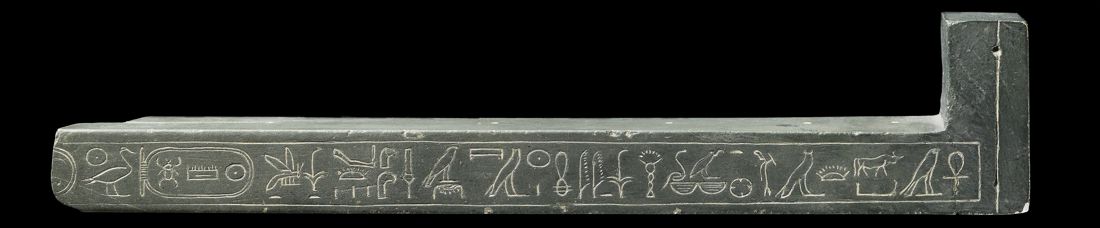
A raised end throws its shadow along a marked bar; summer hours ran longer than winter ones.
- The need
- Egyptian temples and officials divided daylight into twelve hours, but those hours changed length with the season. A small portable instrument that read the sun’s shadow gave a working hour without any calculation.
- How it worked
- The stone is an L: a short upright at one end and a long bar with five marks. Set level and pointed towards the sun, the upright throws a shadow along the bar; as the sun climbs the shadow shortens past the marks, one for each hour. At noon the instrument is turned to face the other way for the afternoon.
- What it changed
- This is the oldest surviving instrument for telling the time of day. A text carved in the cenotaph of Seti I at Abydos, about 1290 BC, explains how such a clock was made and used, the only ancient instruction text for an Egyptian sundial.
- Where it is now
- Ägyptisches Museum und Papyrussammlung, Berlin. Bought by Ludwig Borchardt from a dealer in Cairo; said to come from Hermopolis.
SourcesÄgyptisches Museum Berlin, ÄM 19744 · McMaster AEA, SL Berlin ÄM 19744 · Salmas, “La mesure du temps de la journée”, BIFAO 113 (2014)