
H. Moser & Cie.
- Group
- Independent.
- Headquarters
- Neuhausen am Rheinfall, Switzerland.
- Founded
- 1828
- Founder
- Heinrich Moser
- Known for
- Endeavour, Streamliner, Pioneer, the fumé dials with no logo, Perpetual 1.
- Scale
- About 3,900 watches and CHF 105 million in 2025 (Morgan Stanley estimate).
Lineage and calibres
- 1827
According to Antiquorum's catalogue notes, Johann Heinrich Moser (1805–1874), a Schaffhausen clockmaker's son, moved to St Petersburg around 1827. There, Antiquorum says, he opened a watch business, with a branch in Moscow.
- 1828
H. Moser & Cie. dates its founding to 1828 in St Petersburg, where Moser became the specialist for aristocratic clients. He also built a factory in Switzerland employing several hundred people.
- 1874
After Heinrich Moser's death, his son Henry Moser Jr took over the business. By Antiquorum's account, it sold across Russia as far as Vladivostok and had become a supplier to the Tsar.
- 1890s
Hy. Moser & Cie. made complicated watches for the Russian market, such as a gold grande sonnerie clockwatch with carillon minute repeater, No. 2682, sold by Antiquorum in 2011.
- 1896
Henri Moser & Cie filed a Swiss patent for an improved counter mechanism in chronograph watches (CH 13425, published 1897).
- 1910s
Watches of this period were signed 'Henry Moser & Cie, Le Locle, St. Petersburg, Moscow', such as a 14-carat gold Art Nouveau keyless watch made for the Russian market.
- 2005
Moser Schaffhausen AG filed patents for a perpetual calendar invented by Andreas Strehler and Jürgen Lange. It became the basis of the HMC 800.Calibre
- 2022
The Endeavour Centre Seconds Genesis, made in 50 pieces, paired a watch with blockchain authentication and NFTs. Its owners were later offered the Streamliner Genesis 2.
Contributions to horology
- 1890
Complications for Russia
In the late 19th century Moser supplied the Russian market with minute repeaters, repeating chronographs and grande sonnerie clockwatches. These were signed in Latin and Cyrillic, as surviving watches sold by Antiquorum show.
- 2005
A perpetual calendar without clutter
Moser's perpetual calendar shows the month with a small central hand pointing at the twelve hour markers and the date in a large window. The HMC 800 can be set forwards or backwards at any time. Moser says the calendar is built into the movement rather than added as a module.
- None
Its own hairsprings
Through its sister company Precision Engineering AG, Moser makes its own hairsprings, and its watchmakers pair double hairsprings for some movements. By Moser's account, this is a level of integration few watchmakers have.
From the archive
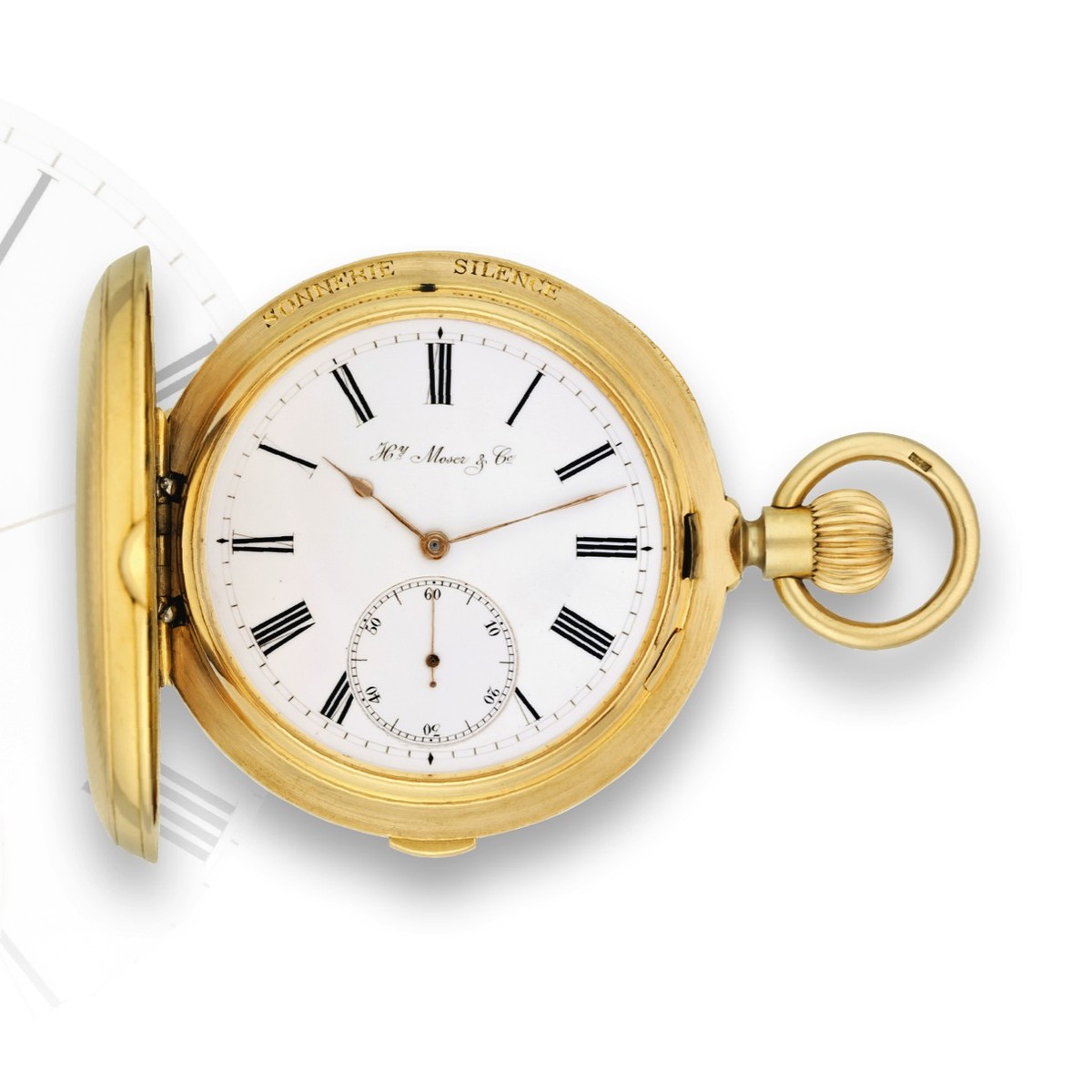
Grande sonnerie clockwatch No. 2682
A gold grande sonnerie clockwatch made for Russia, about 1890.
Popular Models
In the collection as of October 2026.
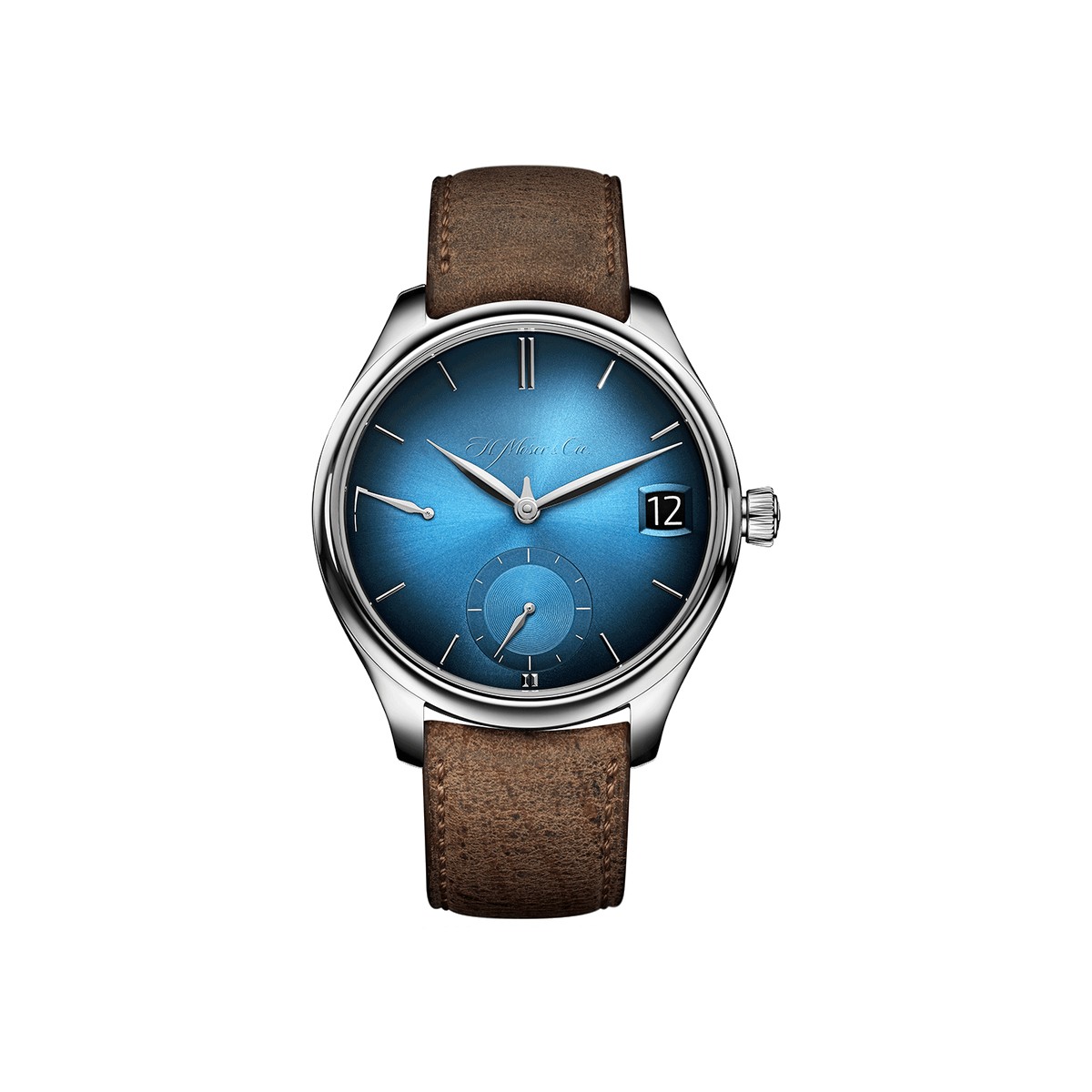
Endeavour Perpetual Calendar Funky Blue fumé
A 42 mm white gold perpetual calendar with a blue fumé dial; HMC 800.
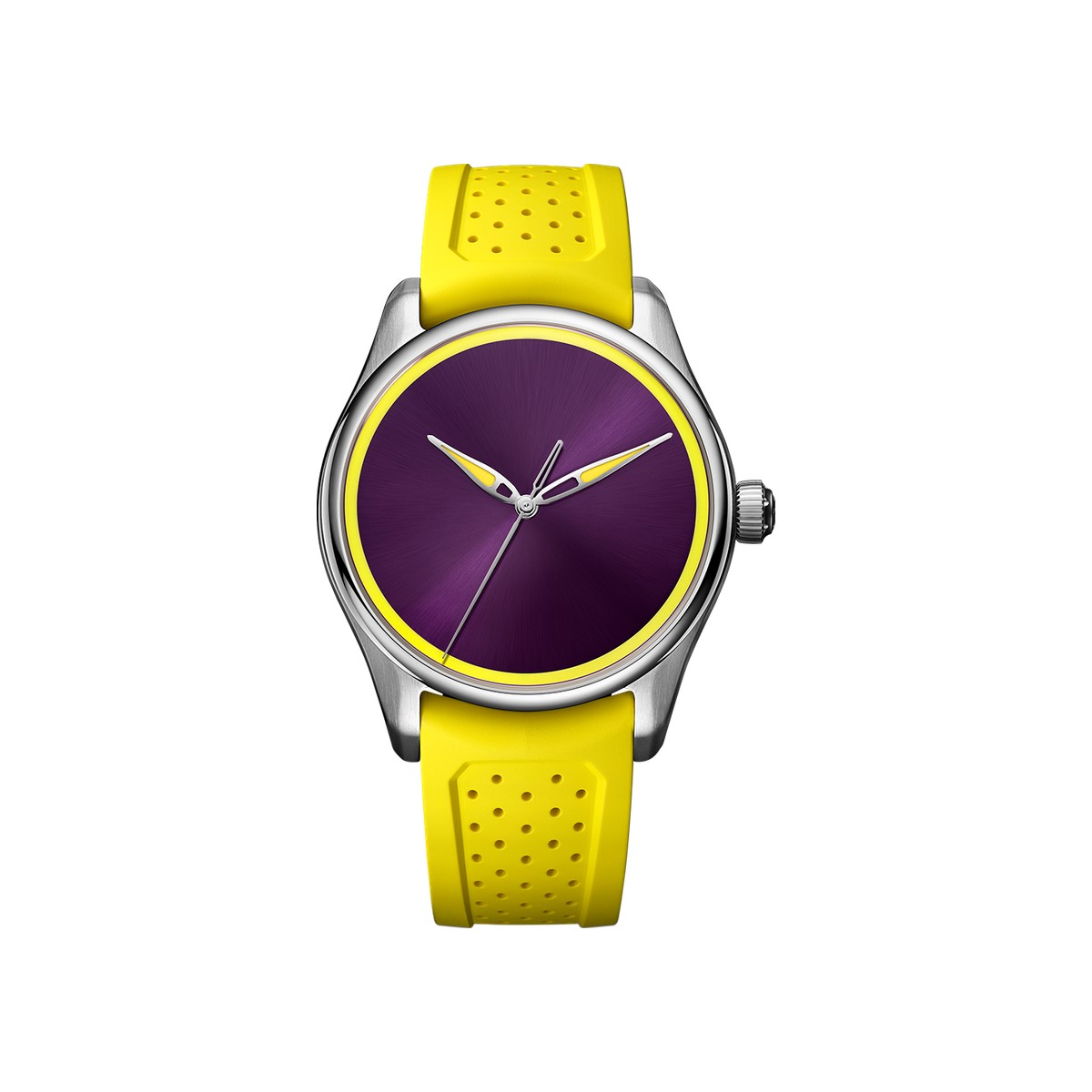
Pioneer Centre Seconds Sun Berry
A 40 mm steel Pioneer with a purple fumé dial and yellow flange; calibre HMC 201.
SourcesH. Moser & Cie., Who we are · H. Moser & Cie., The Manufacture · H. Moser & Cie., Heritage collection · H. Moser & Cie., Streamliner Genesis 2 · Antiquorum, Geneva, 15 October 2000, lot 66, Henry Moser & Cie minute-repeating chronograph No. 51696 · Antiquorum, Geneva, 13 November 2011, lot 97, Hy. Moser & Cie. grande sonnerie clockwatch No. 2682 · Antiquorum, Geneva, 16 October 2005, lot 221, Henry Moser & Cie Art Nouveau keyless watch No. 56426 · Google Patents, CH695227A5 (Moser Schaffhausen AG, 2005) · Google Patents, CH13425A (Henri Moser & Cie, 1896) · H. Moser & Cie., Endeavour Perpetual Calendar Funky Blue fumé 1800-0204 · H. Moser & Cie., Streamliner Retrograde Seconds 6252-1200 · H. Moser & Cie., Pioneer Centre Seconds Sun Berry 3201-1203