
Oris
- Group
- Independent.
- Headquarters
- Hölstein, Switzerland.
- Founded
- 1904
- Founder
- Paul Cattin and Georges Christian
- Known for
- Big Crown Pointer Date, Aquis, Divers Sixty-Five, ProPilot, the in-house Calibre 400.
- Scale
- About 34,000 watches, CHF 52m in 2025; 45th among Swiss brands (estimate).
Lineage and calibres
- 1904
Paul Cattin and Georges Christian bought the recently closed Lohner & Co watch factory in Hölstein and named their company Oris after a nearby brook. The contract was signed before a notary on 1 June 1904.
- 1910s
By 1911 Oris was Hölstein’s largest employer, with more than 300 workers, and it began making wristwatches in the mid-1910s.
- 1927
After Georges Christian died, Jacques-David LeCoultre became Board President. In 1928 Christian’s brother-in-law Oscar Herzog became General Manager, a post he held for 43 years.
- 1938
Oris launched the Big Crown, its first pilot’s watch. Its brochure lists calibre 373 as the first Pointer Calendar movement.Calibre
- 1952
Calibre 601 was Oris’s first automatic pin-lever movement and had a power reserve indicator.Calibre
- 1966
After the Swiss Watch Statute was reversed, Oris produced its first automatic lever-escapement movement, calibre 645. It stayed in the collection for 20 years.Calibre
- 1970
Oris joined ASUAG, the future Swatch Group. During the quartz crisis that followed, its staff fell from about 900 to a few dozen.
- 1982
Dr Rolf Portmann and Ulrich W. Herzog led a management buyout, making Oris independent again and committing it to mechanical watches only.
- 2014
For its 110th anniversary Oris presented Calibre 110, the first movement it had fully developed in 35 years.Calibre
- 2020
Oris introduced the in-house automatic Calibre 400, with a five-day power reserve, high anti-magnetism and a 10-year warranty.Calibre
Contributions to horology
- 1938
Big Crown Pointer Calendar
Oris’s first pilot’s watch showed the date with a centre hand pointing to numbers around the dial edge. It had an oversized crown that could be worked with gloves on. Oris calls the Pointer Calendar its signature design, and it relaunched it in 1984.
- 1945
Precision with the pin-lever
Under the 1934 Watch Statute Oris could not adopt the lever escapement, so it refined its pin-lever movements. Oris says that in 1945 it was the first to receive a distinction for a pin-lever movement. It says the distinction was from the Bureaux Officiels de Contrôle de la Marche des Montres in Le Locle.
- 1966
Ending the Watch Statute
The Watch Statute of 1934 required permission to introduce new technologies. Oris lawyer Dr Rolf Portmann, hired in 1956, campaigned for a decade until it was reversed in 1966, and Oris then launched its own automatic lever-escapement calibre 645.
- 1997
Worldtimer with one-hour jumps
Oris’s calibre 690 Worldtimer lets the wearer move local time forwards or backwards in one-hour jumps with a push-button. Oris calls the movement ground-breaking.
- 2014
Calibre 110
A hand-wound 3 Hz movement with a single barrel giving ten days of power reserve and a non-linear power reserve indicator. The indicator’s notches spread out as the watch runs down. Oris says it patented the indicator and that the combination had never been seen before.
From the archive
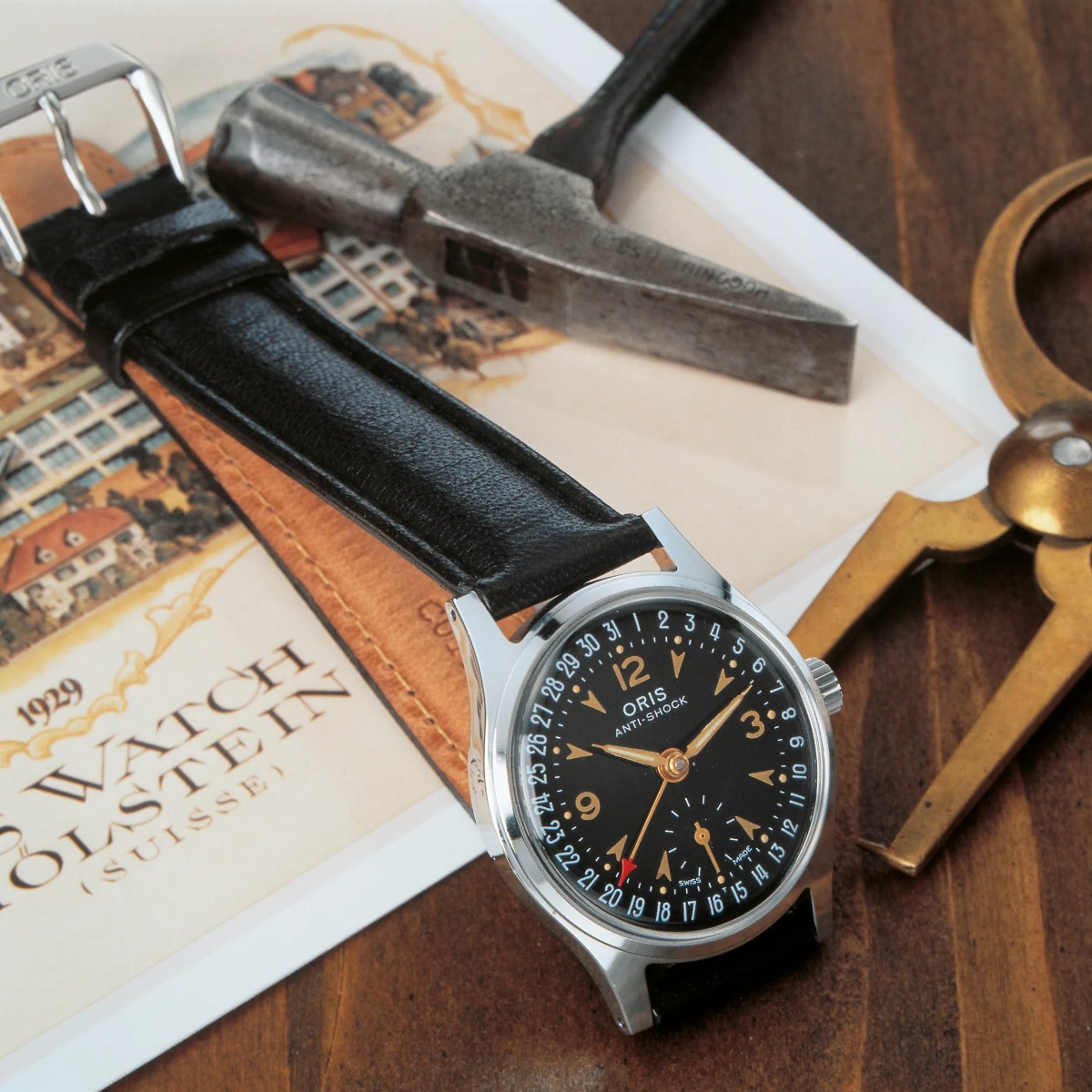
Big Crown Pointer Calendar
The 1938 Big Crown Pointer Calendar, Oris’s first pilot’s watch; not its first wristwatch.
Popular Models
In the collection as of October 2026.
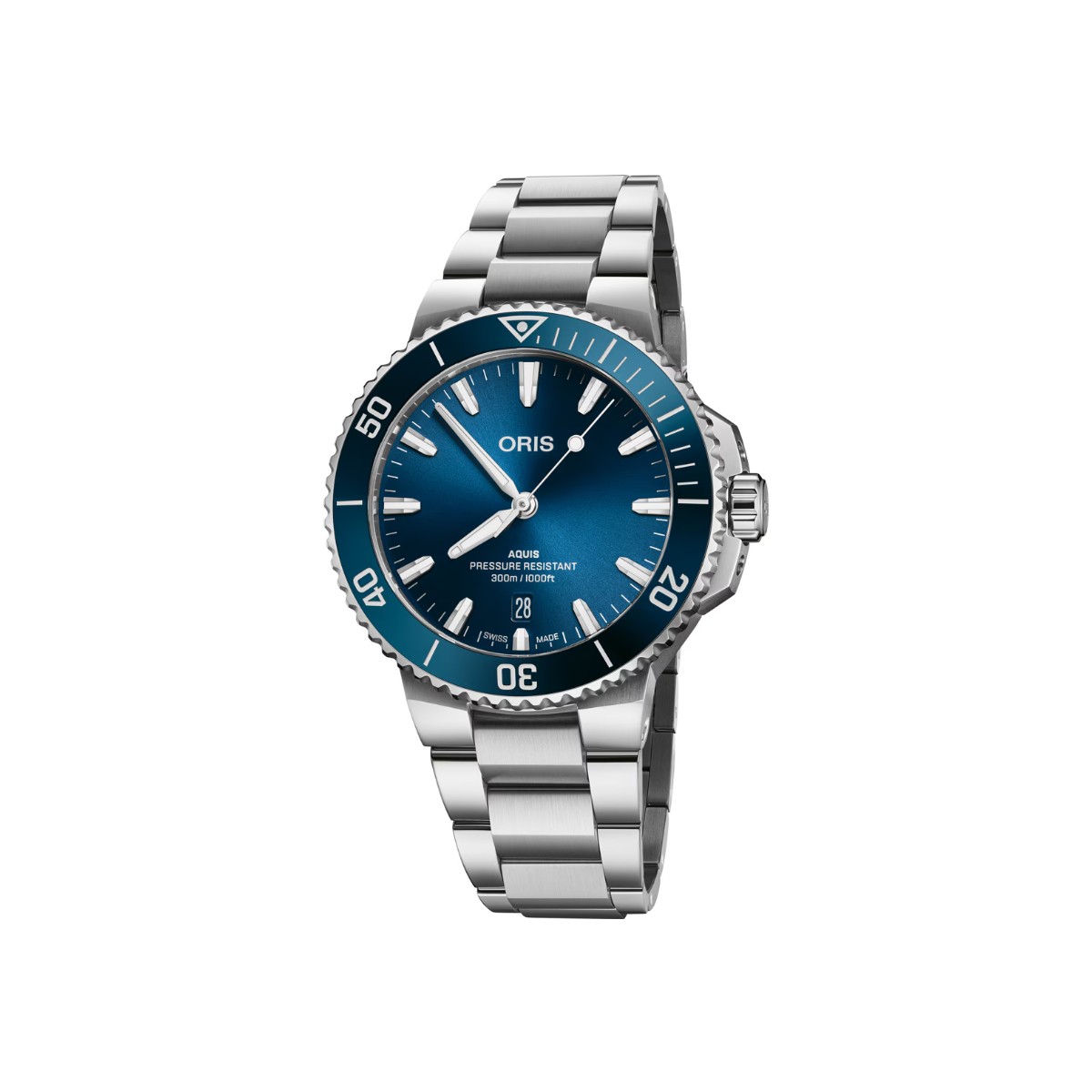
Aquis Date 41.5
A 41.5 mm steel diver with a blue ceramic ring and dial; self-winding calibre 733-1.

Big Crown Pointer Date Bullseye
A 38 mm steel Big Crown with a ‘bullseye’ dial and pointer date; calibre 754-1.
SourcesOris, The history of Oris · Oris, 110 Years brochure (2014) · Oris, Aquis Date 01 733 7787 4135-07 8 22 04PEB · Oris, Big Crown Pointer Date 01 754 7779 4061-07 5 19 25 · uhrenschmuck24.ch (official Oris retailer), Aquis Date 41.5 image · Watches of Switzerland, Big Crown Pointer Date Bullseye image · Morgan Stanley and LuxeConsult, Swiss watch brand estimates, February 2026.