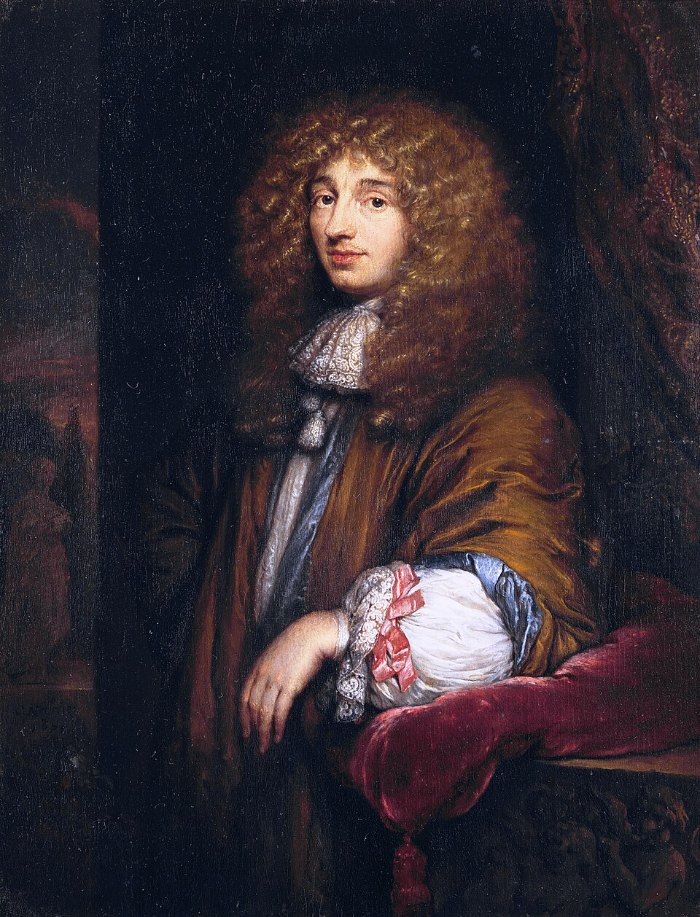
Beginnings
1629Huygens was born in The Hague in 1629. He was the second son of Constantijn Huygens, secretary to the Princes of Orange and a poet and diplomat in his own right.
He was taught at home and read law and mathematics at Leiden and Breda. By his mid-twenties he was grinding lenses with his brother and corresponding with the mathematicians of Paris. He never had to earn a living from clocks. He worked on them because a good clock was a scientific instrument he needed.
What he changed
Pendulum clockBy his own account his first pendulum clock ran on Christmas Day 1656. The States of Holland granted him a patent on 16 June 1657.
The clockmaker Salomon Coster of The Hague built the first examples, one of which survives at Rijksmuseum Boerhaave in Leiden. A clock that had wandered a quarter of an hour a day now kept to a minute.
Pendulum theoryIn the Horologium Oscillatorium of 1673 he worked out why. It covers the mathematics of the swinging weight, the cycloidal cheeks that made its swings equal, and the theory of centrifugal force along the way.
Balance springIn February 1675 he published, in the Journal des Sçavans, a drawing of a balance wheel governed by a spiral spring. He had watches made to it by Isaac Thuret in Paris. That spring is the reason a watch keeps time at all, and it opens this site’s precision story.
Why it matters now
Two lines of descentEvery pendulum clock made for the next 250 years, and every mechanical watch made since, descends from these two ideas.
Astronomy, navigationThe pendulum made astronomy and navigation possible on land.
Instrument, not toyThe spiral spring made the pocket watch an instrument rather than a toy.
Timekeeping as physicsHuygens was also the first to treat a timekeeper as a problem in physics with an answer. This is the habit of mind the whole industry inherited.
Worth knowingHe dated the invention to 1656 and the patent to 1657, which is why both years are quoted. The clock was invented in one year and sold in the next.
Historian’s noteThe balance spring is contested. The Hooke Folio was rediscovered at the Royal Society in 2006. It records Robert Hooke showing a spring-regulated watch to the Society on 23 June 1670, five years before Huygens published. Hooke had the idea and a demonstration first. Huygens published first, and his spiral is the form that every watch adopted. Thuret also claimed the invention in Paris. Galileo had drawn a pendulum clock in 1641 that was never finished.
SourcesMacTutor, University of St Andrews · Linda Hall Library · Antiquarian Horological Society timeline · The Hooke Folio Online