
Junghans
- Group
- Independent.
- Headquarters
- Schramberg, Germany.
- Founded
- 1861
- Founder
- Erhard Junghans
- Known for
- Max Bill (1961), Meister, Mega radio-controlled watches (1990), Form.
Lineage and calibres
- 1861
On 14 April 1861 Erhard Junghans and his brother-in-law founded the component factory 'Zeller & Junghans'. It was in a former oil mill in the Lauterbach valley at Schramberg.
- 1866
After first making parts for Black Forest clocks, such as cases, hands, hinges and pendulum discs, the firm produced its own first clocks in 1866.
- 1888
Junghans registered a five-pointed star trademark with a 'J' at its centre. Two years later the star, a stylised gear wheel, became eight-pointed and carried the full brand name.
- 1936
Junghans began fitting wristwatches with movements of its own design in the 1930s. Calibre J80, with indirect centre seconds, appeared in 1936, and its finest version, J80/2, powered the Meister watches.Calibre
- 1950
Junghans began making the J88 chronograph calibre.Calibre
- 1956
Junghans was Germany's largest chronometer maker in 1951 and, by its account, the world's third largest in 1956. That year Diehl GmbH acquired a majority of the shares.
- 1957
The J83 automatic chronometer calibre followed in 1957.Calibre
- 1961
From 1961 the Swiss Bauhaus-trained designer Max Bill designed wristwatches for Junghans. In its centenary year the firm had 6,000 employees making 20,000 watches a day.
- 1972
Junghans was official timekeeper of the Munich Olympic Games, and its quartz calibre W666.02 entered series production.Calibre
- 2009
Egana Goldpfeil, owner since 2000, ran into difficulties and Junghans became insolvent. Then Dr Hans-Jochem Steim and Hannes Steim took over the company in February 2009.
Contributions to horology
- 1950
J88 chronograph for the Bundeswehr
Junghans's hand-wound J88 chronograph calibre, with 19 jewels, a column wheel and a Breguet balance spring, was made from 1950 to 1964. It won the contract for the Bundeswehr's pilots' watch and was later sold to civilians.
- 1957
J83 automatic chronometer
Junghans calls the J83 of 1957 its first automatic chronometer calibre. It had a screw balance and fine regulation. It came when, by the brand's account, Junghans was the world's third-largest chronometer maker.
- 1970
Astro-Quartz
Junghans began work on a quartz wristwatch in 1967. In 1970 it showed a pre-production series of the Astro-Quartz, which it calls the first German quartz wristwatch. Its calibre W666.02 entered series production in 1972.
- 1990
Mega 1 radio-controlled wristwatch
Junghans presented a radio-controlled table clock for private use in 1985. It then shrank the technology into the Mega 1 wristwatch of 1990, designed with frog design. Junghans calls the Mega 1 the world's first radio-controlled wristwatch.
- 1993
Radio-controlled solar watch
Junghans engineer Wolfgang Ganter showed a solar-powered radio-controlled prototype in spring 1992, and it entered series production in January 1993. In 1995 the antenna was built into a ceramic case for the Mega Solar Ceramic.
From the archive
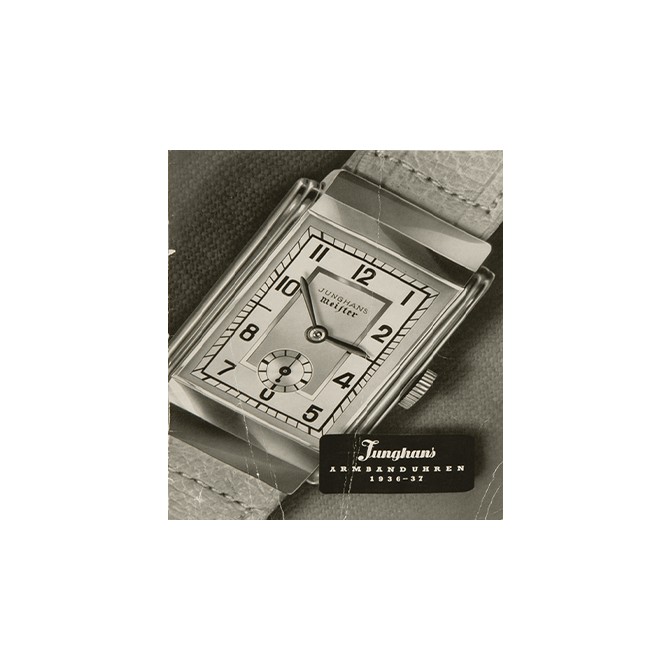
Junghans Meister, 1936–37 catalogue
A Meister from the 1936–37 catalogue, the earliest wristwatch Junghans shows.
Popular Models
In the collection as of October 2026.
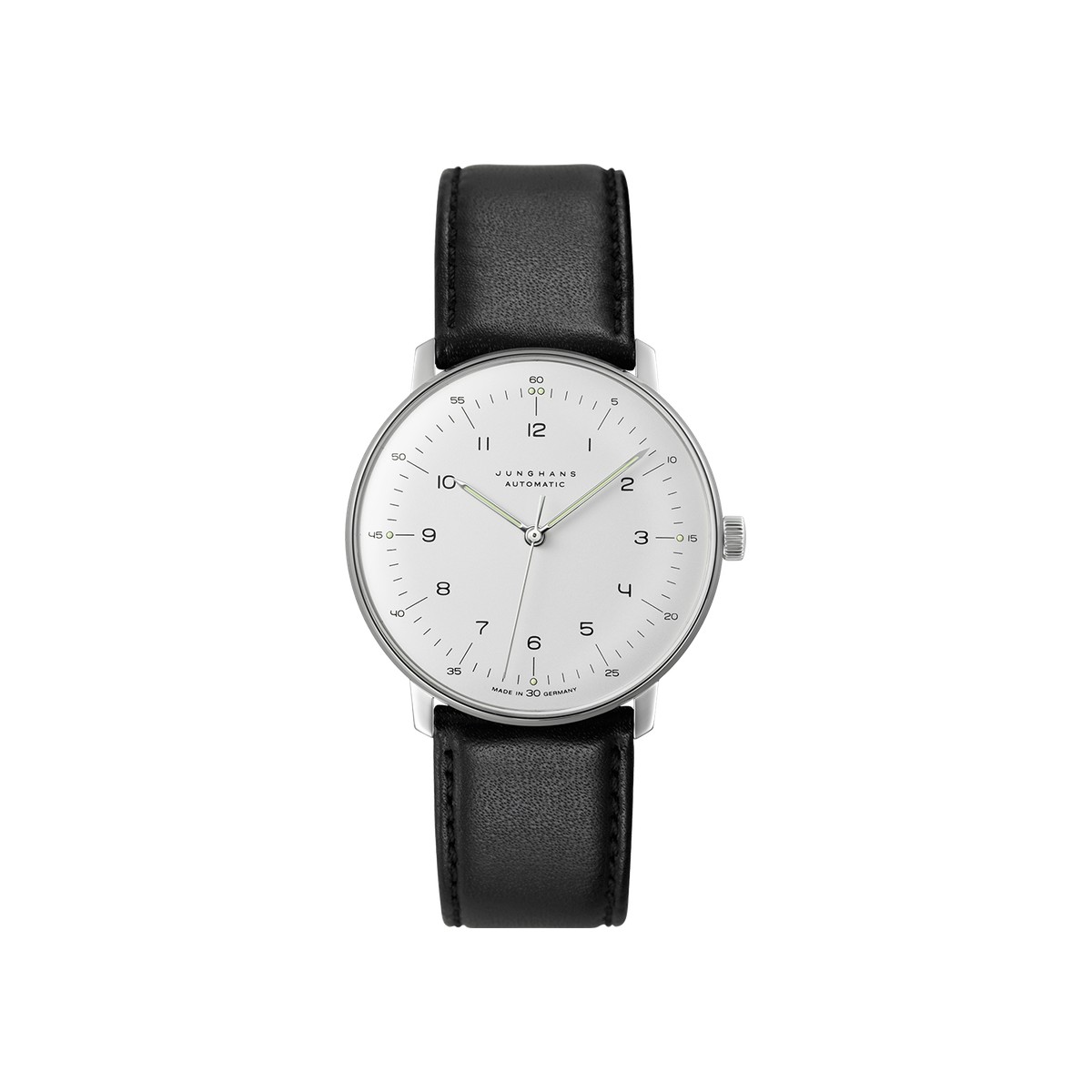
max bill Automatic
A 38 mm steel max bill with a matt silver-plated dial; calibre J800.1.
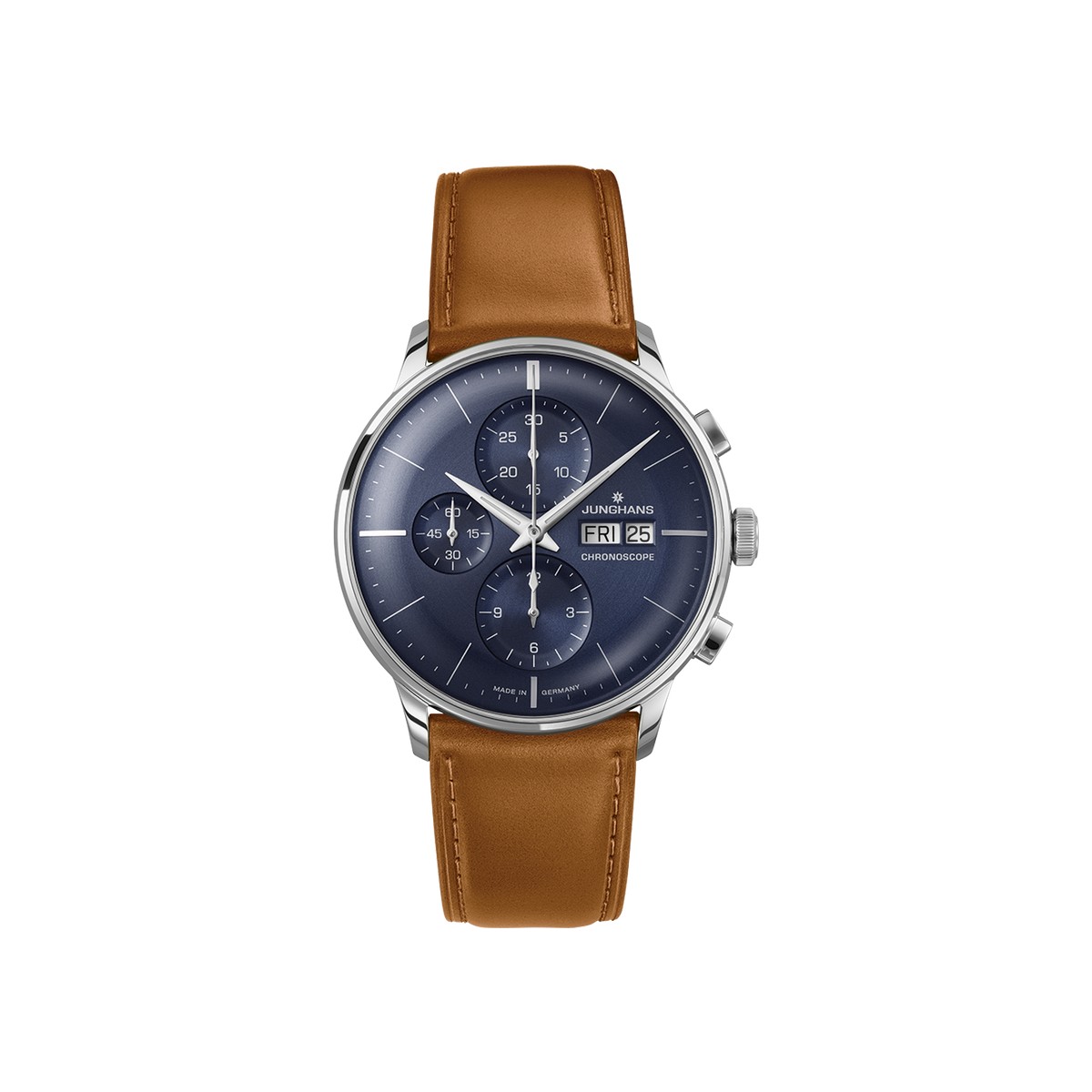
Meister Chronoscope
A 40.7 mm steel chronograph with a blue dial and day-date; calibre J880.1.
SourcesJunghans, The Company: history timeline (Uhrenfabrik Junghans GmbH & Co. KG) · Junghans, max bill Automatic 27/3400.02 · Junghans, Meister Chronoscope 27/4526.03 · Junghans, 1972 Competition 27/4504.00 · Junghans, max bill Automatic 27/3500.02