
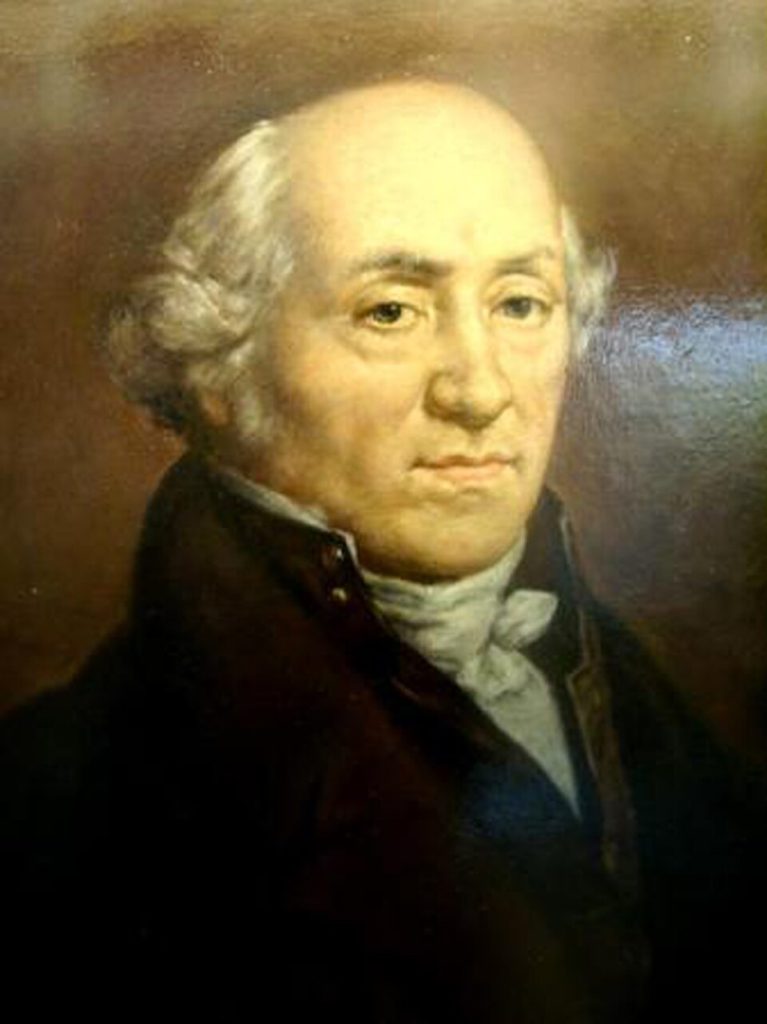
Beginnings
Breguet was born in Neuchâtel in 1747. His father died when he was eleven, and his mother’s second husband, the watchmaker Joseph Tattet, steered him into the trade; he was apprenticed at Versailles from 1762 and studied mathematics in the evenings at the Collège Mazarin. In 1775 he opened his own workshop on the quai de l’Horloge on the Île de la Cité, and his clients soon included the court. When the Revolution turned on the court’s suppliers, his fellow Neuchâtelois Jean-Paul Marat arranged the pass that let him escape to Switzerland in 1793; he came back in 1795 and rebuilt the business, with Napoleon, the Tsar and the Sultan among the buyers.
What he changed
In 1783 he replaced the bell in repeating watches with a coiled steel wire, the gong spring, which every chiming watch has used since. In 1790 came the pare-chute, a sprung bearing that saved the balance staff when a watch was dropped. On 26 June 1801 he patented the tourbillon, a cage that turns the whole escapement once a minute to average out the errors of position. He gave the balance spring its raised terminal curve, the Breguet overcoil, and watches the thin blued hands with hollow moons and the sloping numerals that still carry his name. In 1810 he recorded the order for no. 2639, a watch for the wrist of Caroline Murat, Queen of Naples, the earliest wristwatch known.
Why it matters now
A great deal of what a watch buyer calls fine watchmaking is Breguet’s work three lifetimes on: the gong in every repeater, the overcoil in every chronometer, the tourbillon in every showpiece. He is one of the few watchmakers whose name is also a brand, which has kept his archive alive and his claims examined.
Worth knowingWatch no. 160, ordered in 1783 for Marie-Antoinette by an unknown officer of her guard with no limit on time or cost, was finished in 1827, four years after Breguet’s death. It was stolen from a Jerusalem museum in 1983 and came back in 2007.
Historian’s noteTwo things often said of him are not in the record: that he was Perrelet’s pupil, and that Marie-Antoinette’s lover ordered no. 160. The name of his Versailles master is unknown.
SourcesDictionnaire historique de la Suisse · FHH · Breguet · SJX