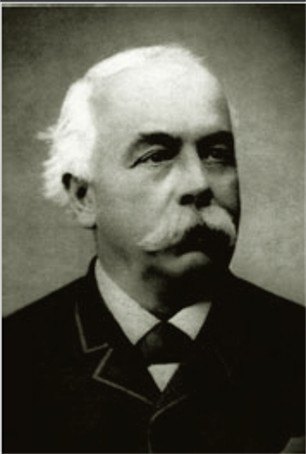
Beginnings
Heuer was born in 1840 at Brügg, outside Bienne, the son of a shoemaker, and was apprenticed at Saint-Imier from fourteen. At twenty, in 1860, he opened his own workshop there, and within a few years moved the business to Bienne, where it stayed. He was a founder of the Banque Populaire de Bienne and sat on the town council; his sons Jules-Édouard and Charles-Auguste took the firm on when he died at fifty-two.
What he changed
A chronograph has to connect its seconds hand to the running train when you press start and disconnect it when you press stop. Heuer’s answer, patented in Germany on 6 February 1887 and in France on 3 May, was a small pinion with two sets of teeth that tilts into and out of mesh: cheap to make, quick to engage, and gentle on the hands. The United States patent of 1888 carries the same date and drawing. When Switzerland passed its first patent law in 1888 he was among the first filers, with a repeater mechanism. By then the house was building chronographs in series and selling them to the sportsmen and racers who would define its name.
Why it matters now
The oscillating pinion is still in production: it is the coupling in the Valjoux 7750 and in TAG Heuer’s own calibres, which means it is in more chronographs than any other device. The chronograph page on this site explains where it sits.
Worth knowingSwitzerland had no federal patent law until 1888, so a Swiss inventor of 1887 had to patent abroad; Heuer did, in Berlin and Paris.
Historian’s noteThe “1869 patent for keyless crown winding” that the modern house repeats cannot be a Swiss patent, since none existed, and no foreign number has been produced; this site treats it as a house claim. The date of the move to Bienne is given as 1864 in the Dictionnaire du Jura and 1867 in the Dictionnaire historique de la Suisse. Business Montres has questioned whether the oscillating pinion was entirely his; the 1887 patents are the earliest record.
SourcesDictionnaire du Jura · Dictionnaire historique de la Suisse, TAG Heuer · US patent 377,896 · Swiss Federal Institute of Intellectual Property, the first Swiss patent