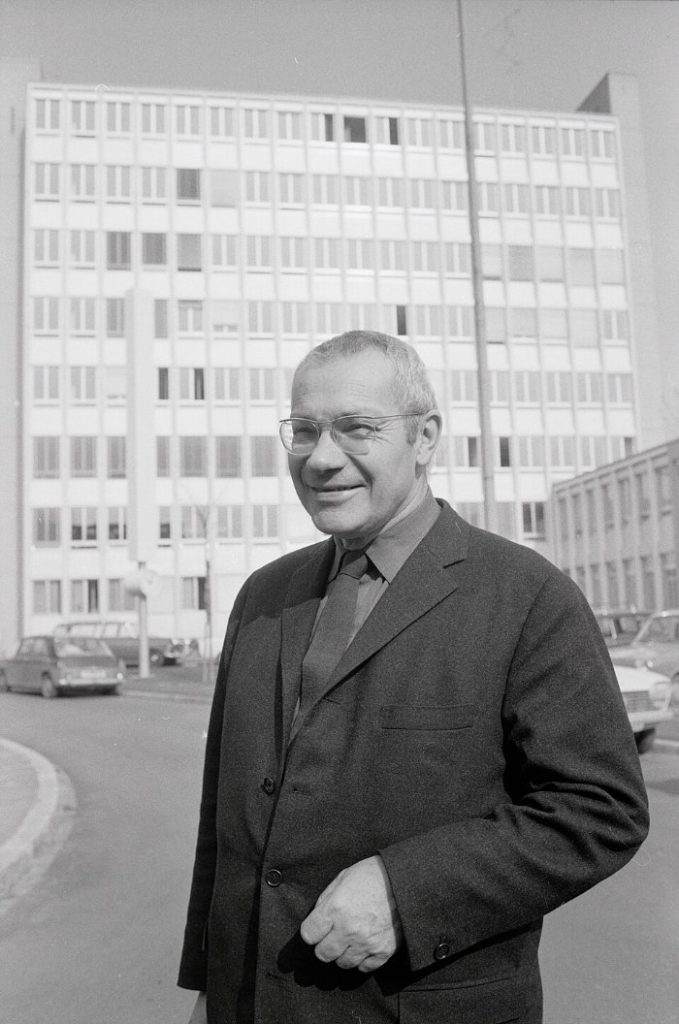
Beginnings
1908Bill was born in Winterthur in 1908.
He trained as a silversmith at the Zürich school of applied arts.
1927In 1927 he went to the Bauhaus in Dessau, where Klee, Kandinsky, Schlemmer and Albers taught him.
1929Back in Zürich from 1929 he worked as an architect, painter, sculptor and typographer at once, and became the leading figure of concrete art.
1950In 1950 he co-founded the Hochschule für Gestaltung in Ulm.
He designed its buildings and was its first rector until 1956.
What he changed
Kitchen clockThe Junghans work began at Ulm. In 1956 he and his students designed a ceramic kitchen clock with a timer.
Clocks and wristwatchWall and table clocks followed at the end of the 1950s, and in 1962 the first wristwatch with a hand-wound Junghans movement.
Grid dialsThe dials are the point: numerals or batons drawn to a grid, hands of exact length, nothing that does not help you read the time.
Later lifeHe went on to sit on the Zürich city council and in the Swiss parliament, and kept making sculpture until the end.
Why it matters now
Still madeThe Junghans watches are still made, practically unchanged, and a whole category of plain, legible dress watches is drawn from them, usually without credit.
Bauhaus linkBill is the link between the Bauhaus of the 1920s and the watch of today.
Dial as designHe is also the proof that a dial can be a piece of design in its own right.
Worth knowingHe was a member of the Swiss National Council from 1967 to 1971, for the Alliance of Independents.
Historian’s note“The Bauhaus watch” is a shop phrase. Bill’s Junghans designs date from 1956 to 1962, a quarter of a century after the school closed, and grew out of Ulm. Junghans dates the first wristwatch to 1962, but 1961 is often quoted. He died at Tegel airport in Berlin, not in Zürich.
SourcesDictionnaire historique de la Suisse · Bauhaus Kooperation · HfG-Archiv Ulm · Junghans Archiv, Kleinuhren-Chronik