Timeline / An early astronomical watch
An early astronomical watch
About 1600–1610 a Paris watch by Nicolas Forfaict already showed the moon’s age and phase and the angle between sun and moon: one of the earliest surviving astronomical watches.
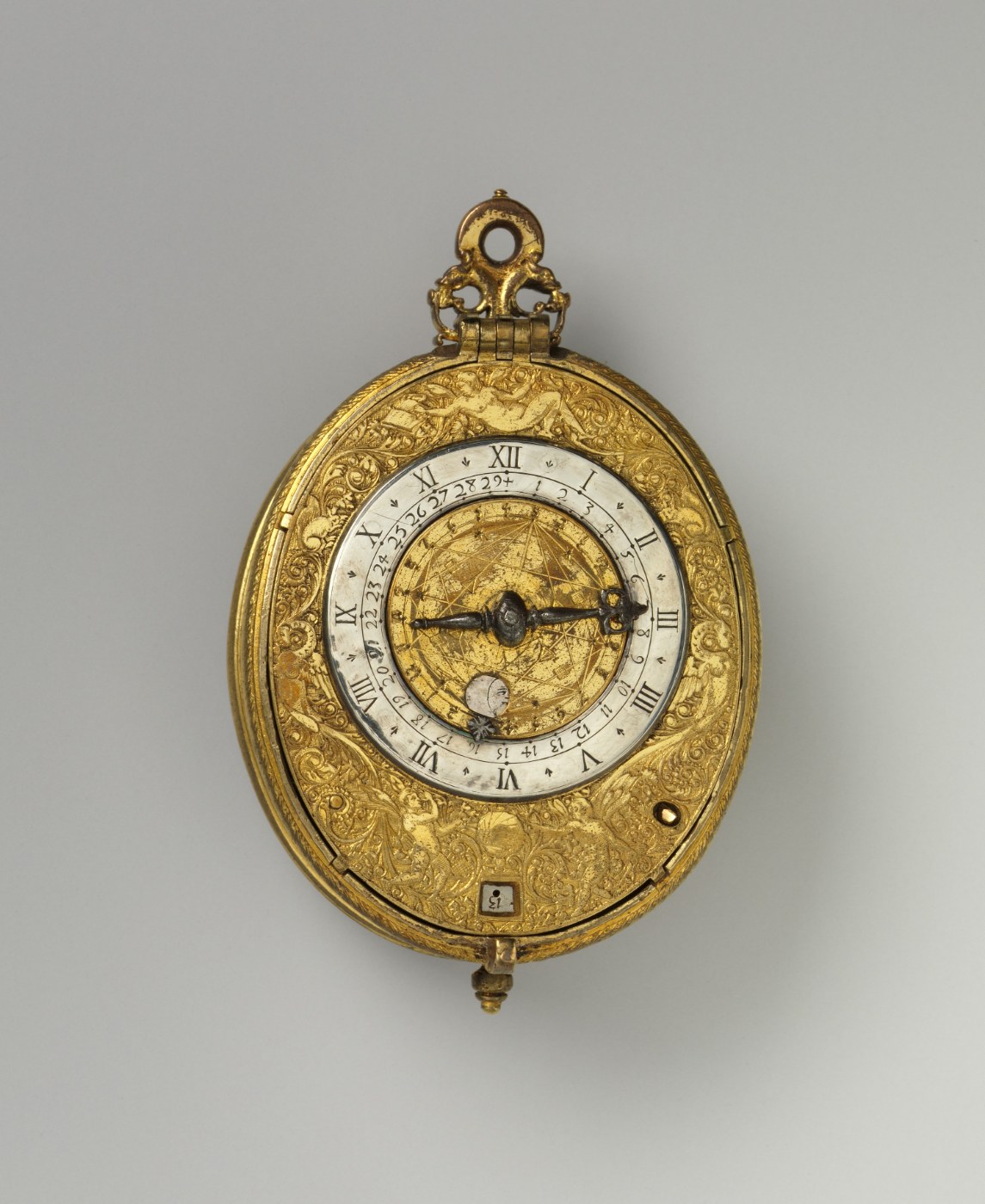
- The need
- Owners of the new pocket watches wanted them to do what almanacs and astronomical clocks did: tell the age and phase of the moon, which decided how much light there would be for a journey after dark, and the moon’s place against the sun that astrologers read.
- Made by
- Nicolas Forfaict, a watchmaker working in Paris from about 1580 to 1615.
- What was new
- A watch 5.4 cm high that, besides the hours on a single hand, shows the day of the month, the moon’s age with a small hand, its phase through an aperture, how long the moon shines after sunset at the edge of the disc, and an aspectarium: a dial of the angle between the sun and the moon in the zodiac. It also strikes the hours on a bell and has an alarm.
- Worth knowing
- Dials like this were spreading on watches in the same decade. A London watch signed H Roberts, also from about 1600–1610 and now in the British Museum, adds the signs of the zodiac and separate pointers for the sun and the moon. Neither watch is dated on the object; the dates are the museums’.
- Where it is now
- The Metropolitan Museum of Art, New York (17.190.1607), given by J. Pierpont Morgan in 1917.
Historian’s noteNo museum claims a first astronomical watch, and none is claimed here. This is one of the earliest surviving examples, documented by the museum that holds it. Another Met watch is sometimes said to date from 1583, but the museum believes that inscription was added later.
SourcesThe Metropolitan Museum of Art · The Met, Seventeenth-Century European Watches · British Museum, 1856,0429.1
Suggest a correction