Timeline / The pendulum clock
The pendulum clock
Invention
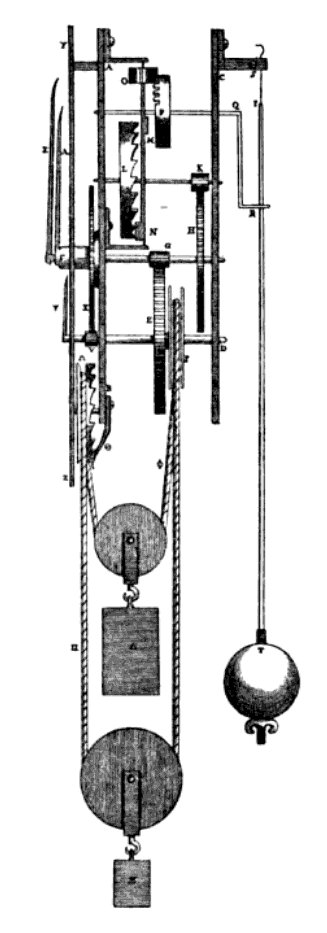
Christiaan Huygens ran his first pendulum clock on Christmas Day 1656 and patented it in June 1657; Salomon Coster built it, and clocks went from losing a quarter of an hour a day to a minute.

- The need
- A clock of 1650 had a balance with no spring and could lose or gain a quarter of an hour a day. Astronomers and navigators needed something that kept a steady beat.
- Made by
- Designed by Christiaan Huygens in The Hague; built by the clockmaker Salomon Coster under the patent granted by the States of Holland on 16 June 1657.
- What was new
- The pendulum, swinging under gravity, took over from the balance as the regulator. Its period depends on its length, not on the force driving it, so the clock kept to about a minute a day, and Huygens later added cycloidal cheeks to make long and short swings take the same time.
- Worth knowing
- Huygens dated the invention to 25 December 1656 and the patent to June 1657, which is why both years are quoted. The earliest surviving Coster clock, of 1657, is at Rijksmuseum Boerhaave in Leiden.
- Where it is now
- Rijksmuseum Boerhaave, Leiden, holds a Coster pendulum clock of 1657; Huygens’s treatise, the Horologium Oscillatorium of 1673, gives the theory.
Historian’s noteGalileo had drawn a pendulum clock in 1641 and his son Vincenzo began to build it, but it was never finished. Huygens’s is the first that ran and was sold. See the page on Christiaan Huygens.
SourcesLinda Hall Library · MacTutor, University of St Andrews · Antiquarian Horological Society timeline
Suggest a correction