Timeline / The lever escapement
The lever escapement
Invention
About 1754 Thomas Mudge of London fitted a timekeeper with a detached lever between escape wheel and balance; his gold watch of 1770 for Queen Charlotte is the earliest lever watch known, and nearly every mechanical watch since uses the idea.
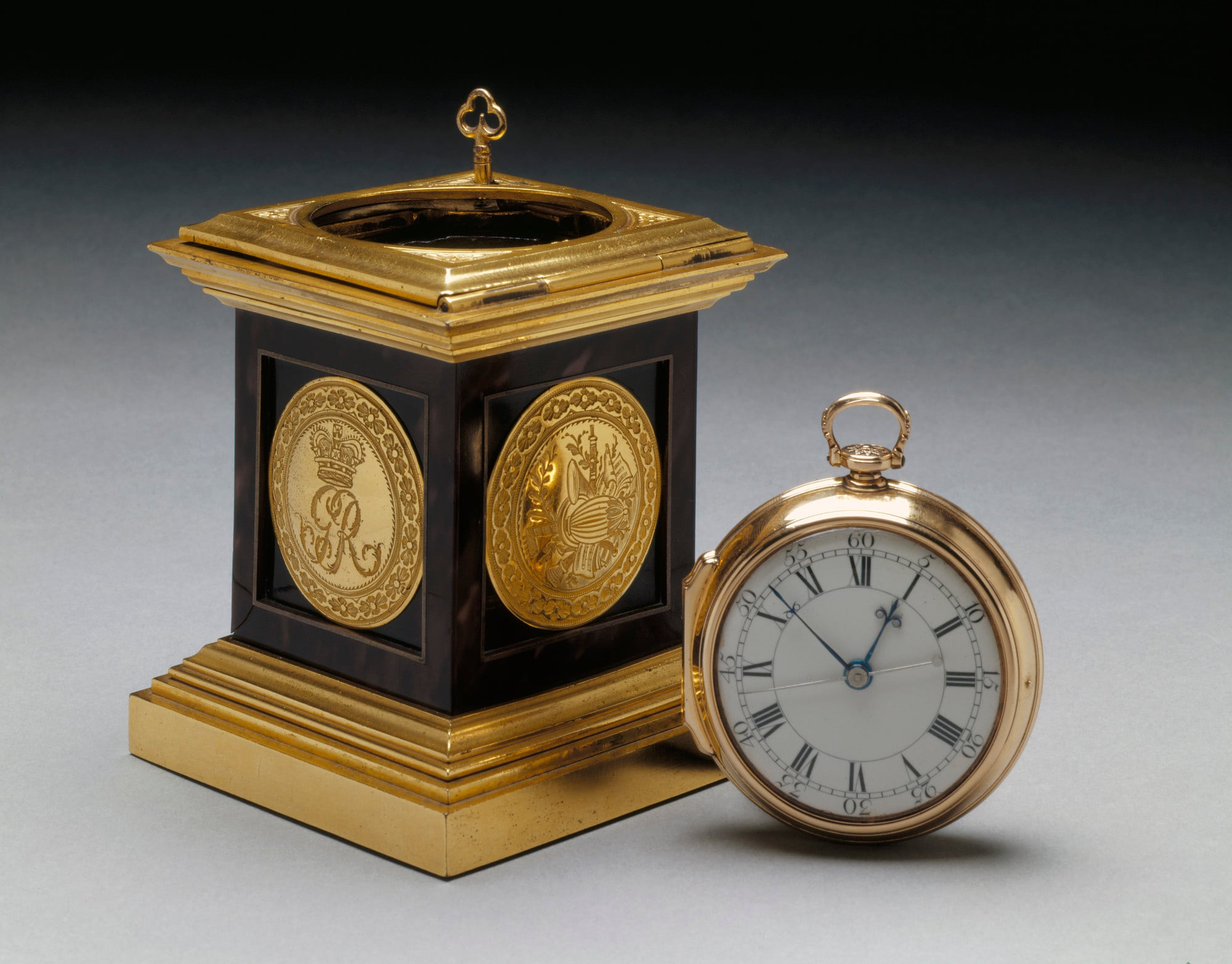
- The need
- The verge and the cylinder escapements of the 1750s both kept the balance in constant contact with the train, so every variation in the mainspring’s force reached the balance and upset the rate.
- Made by
- Thomas Mudge, Fleet Street, London, a pupil of George Graham.
- What was new
- A separate lever between the escape wheel and the balance. The escape wheel gives the lever an impulse, the lever passes it to the balance through a pin, and then the balance swings free until it returns, with nothing touching it. The rate no longer depended on the state of the mainspring.
- Worth knowing
- Mudge made very few lever watches and did not pursue the idea; his own marine timekeepers used a constant-force escapement. It was English makers around 1800, then the Swiss, who made the lever universal.
- Where it is now
- The lever watch of 1770, bought by George III for Queen Charlotte, is in the Royal Collection (RCIN 63759). Mudge’s first marine timekeeper is in the British Museum.
Historian’s noteThe date is approximate. The Antiquarian Horological Society dates the first use to an experimental marine timekeeper of 1754. Other sources say “by 1755” or 1757. The earliest watch with the escapement that survives is the 1770 piece. See the page on Thomas Mudge.
SourcesRoyal Collection Trust · Antiquarian Horological Society timeline · Science Museum Group
Suggest a correction