Archives: Milestones

  • Keyless winding

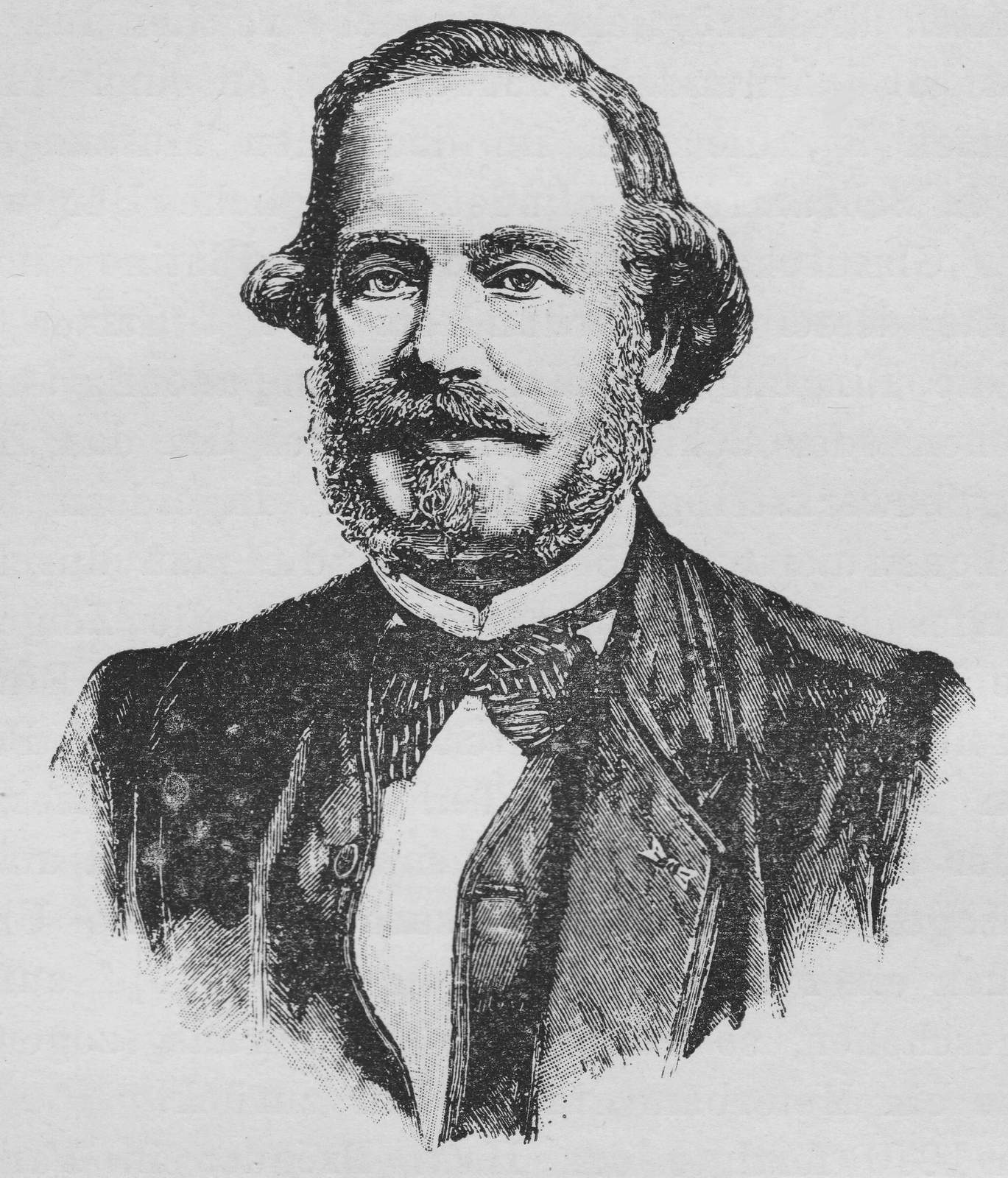
    Portrait of Adrien Philippe
    Adrien Philippe (1815–1894), who patented the sliding pinion that put winding and setting into the crown.Photograph: Karel K. · Public domain · Wikimedia Commons
    The need
    Watches were wound and set with a separate key. Keys were lost, dials were scratched, and every winding opened the case to dust.
    Made by
    Jean-Adrien Philippe, a French watchmaker. He showed it at the Paris Industrial Exposition of 1844, where it won a bronze medal, and patented it in 1845.
    What was new
    A sliding pinion behind the crown. Pushed in, the crown winds the mainspring; pulled out, it turns the hands.
    Worth knowing
    The exhibition brought Philippe to the notice of Antoine Norbert de Patek, and he joined Patek’s firm the following year: the origin of Patek Philippe. The same arrangement is in practically every mechanical watch made since. Closing the case this way is what later made dust-proof and waterproof watches possible.
    Where it is now
    The principle, not an object, is the milestone.

    Historian’s notePopular accounts give 1842 and credit Philippe alone. Thomas Prest patented winding through the pendant in London in 1820, Louis Audemars worked on a Swiss system from 1838, and Adolphe Nicole patented keyless work in 1844. Philippe’s contribution was combining winding and hand-setting in one control that worked.

    SourcesPatek Philippe Museum · Patek Philippe
  • The first chronograph

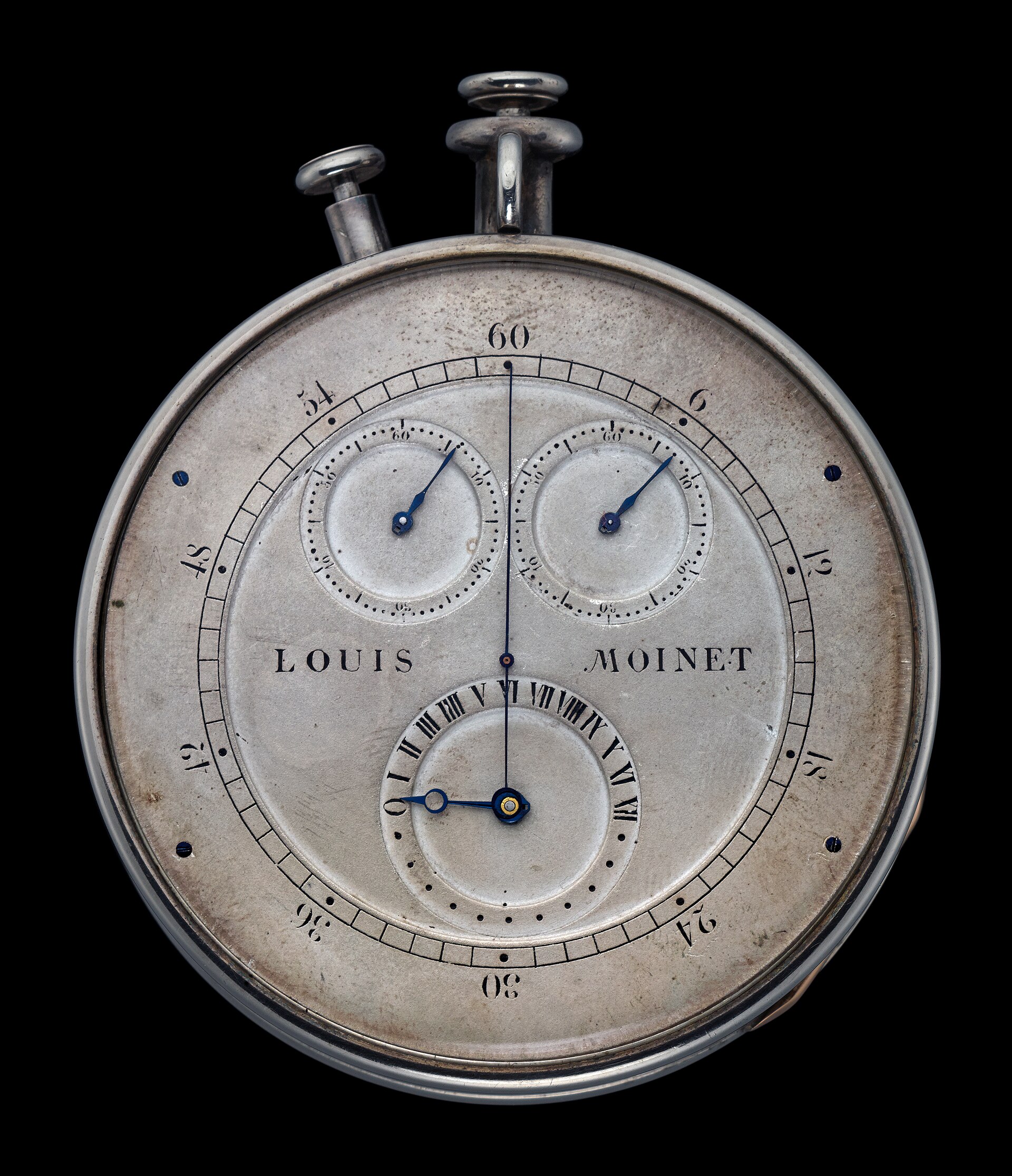
    Louis Moinet compteur de tierces of 1816
    Moinet’s compteur de tierces of 1816 — the instrument itself.Photograph: LouisMoinet · CC BY-SA 3.0 · Wikimedia Commons
    The need
    Timing astronomical observations to a fraction of a second.
    Made by
    Louis Moinet, a Paris watchmaker, teacher and author, for his own work at the telescope.
    What was new
    The three controls that define a chronograph: start, stop and return to zero. It beat at 216,000 vibrations an hour and could measure a sixtieth of a second.
    Worth knowing
    It was unknown until it came to light in 2012 and was presented in 2013. Until then the first chronograph was said to be Nicolas Rieussec’s of 1821, which marked the dial with a drop of ink and gave the device its name: chronograph means time-writer.
    Where it is now
    Owned by the modern Louis Moinet watch company, which uses his name but does not descend from his workshop.

    Historian’s noteThe 1816 date comes from Moinet’s own papers. Some argue that a counter which records nothing is a chronoscope, not a chronograph, so that Rieussec keeps the title on the strict meaning of the word.

    SourcesLouis Moinet

  • The first modular automatic chronograph

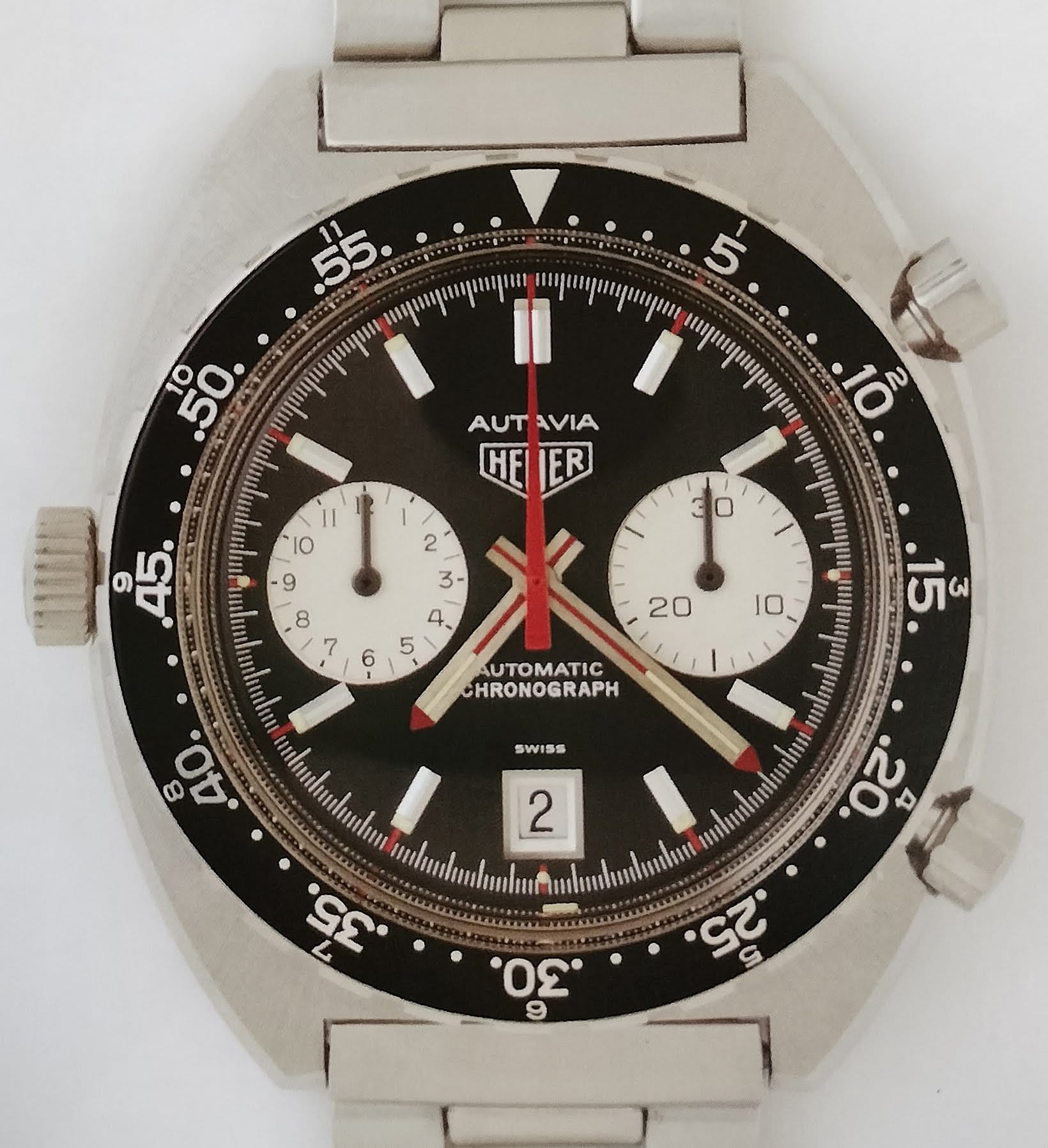
    Heuer Autavia reference 1163 with the Chronomatic Calibre 11
    A Heuer Autavia reference 1163 with Calibre 11, one of the watches launched with the movement.Photograph: EMore98 · CC BY-SA 4.0 · Wikimedia Commons
    The need
    Chronographs were hand-wound; the market wanted a self-winding one, and the Swiss makers wanted it first.
    Made by
    A consortium, codenamed Project 99 and formed in 1966: Heuer-Leonidas and Breitling, with Hamilton-Büren supplying the automatic base and Dubois Dépraz the chronograph module.
    What was new
    A modular build: Büren’s thin micro-rotor movement with a separate chronograph module mounted on it.
    Worth knowing
    The stacking put the crown on the left of the case and the pushers on the right, the signature of the Heuer Monaco, Autavia and Carrera and the Breitling Chrono-Matic. Announced on 3 March 1969 in Geneva and New York; in shops from about July.

    Historian’s noteCalibre 11 is modular, not integrated, and it reached shops after Seiko’s 6139 had gone on sale in Japan. Its claim is the first automatic chronograph sold internationally.

    SourcesTAG Heuer

  • The first automatic chronograph sold

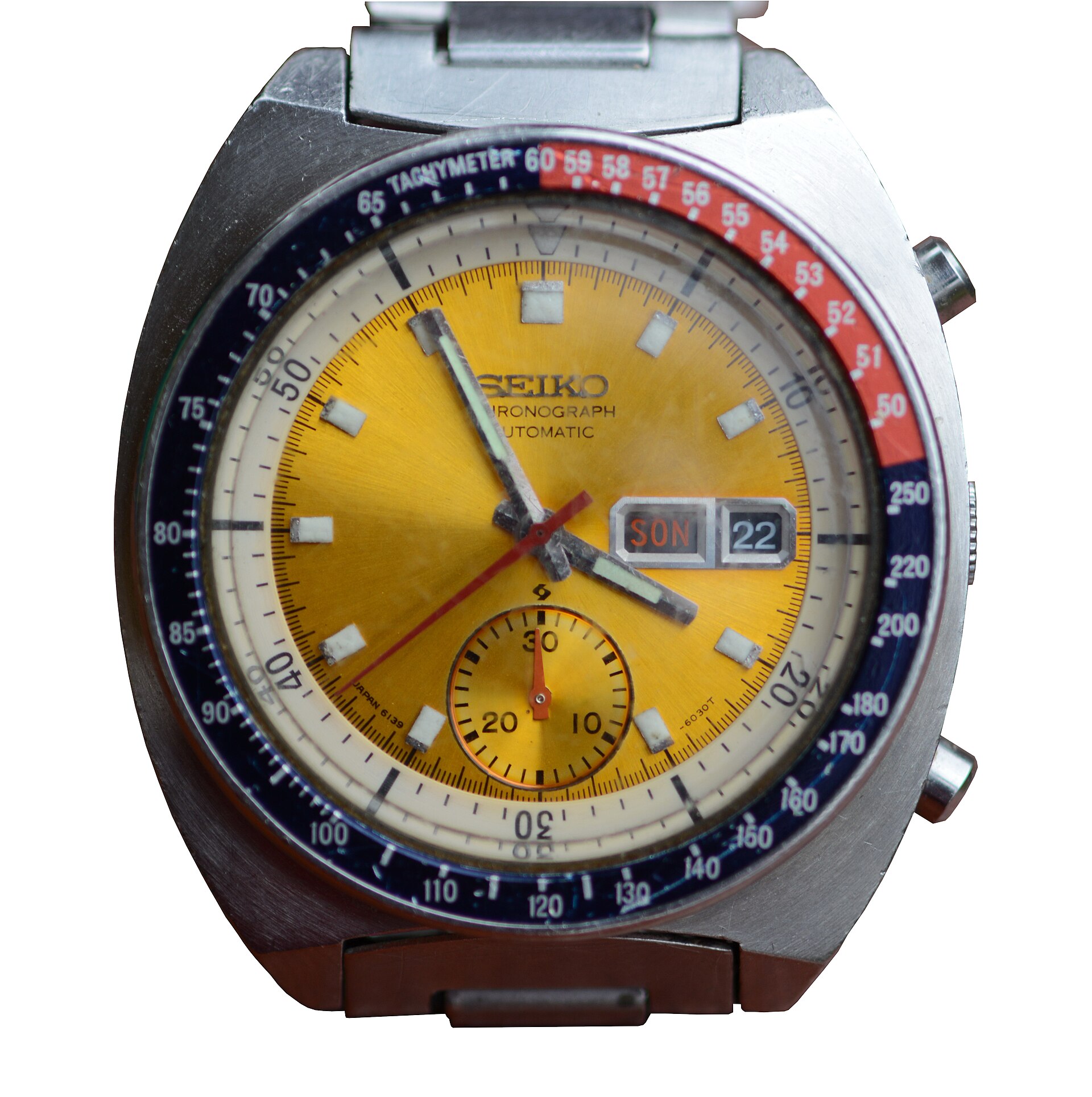
    Seiko 6139 automatic chronograph with yellow dial
    A Seiko calibre 6139 with the yellow dial, the version known as the Pogue.Photograph: File:Seiko Automatic-Chronograph Cal. 6139 mit gelbem Zifferblatt, die sogenannte „Pogue Seiko“.jpg: Dnalor 01 derivative work: Pittigrilli · CC BY-SA 3.0 · Wikimedia Commons
    The need
    Chronographs were hand-wound because there was no room left in the movement for a winding rotor.
    Made by
    Suwa Seikosha, part of Seiko. Sold in Japan only at first.
    What was new
    A self-winding chronograph designed as one movement, with a column wheel, a vertical clutch and Seiko’s Magic Lever winding.
    Worth knowing
    Seiko did not know there was a race and made no announcement. The yellow-dial version is called the Pogue, after the astronaut William Pogue, who wore his own on the Skylab 4 mission in 1973.

    Historian’s noteThere is no single winner. First announced: Zenith, January 1969. First on sale: Seiko, May 1969, in Japan. First on sale internationally: the Calibre 11 group, July 1969.

    SourcesSeiko Museum Ginza

  • The first high-beat chronograph

    The need
    Chronograph wristwatches were all hand-wound, and the usual rates could only time to a fifth of a second.
    Made by
    Zenith of Le Locle. Announced on 10 January 1969.
    What was new
    A self-winding chronograph designed as a single movement, with the rotor, column wheel and chronograph built together rather than stacked, beating at 36,000 vibrations an hour where rivals beat at 19,800 or 21,600.
    Worth knowing
    Zenith announced first but delivered last of the three 1969 automatic chronographs. When its American owners stopped production in 1975, the watchmaker Charles Vermot hid the tools and plans in the factory attic instead of scrapping them, which let the calibre return in the 1980s. Rolex used it in the Daytona from 1988 to 2000.

    Historian’s noteFirst integrated self-winding chronograph is disputed: Seiko’s 6139 was also integrated and already in production. First chronograph at 36,000 vibrations an hour is not disputed.

    SourcesZenith

  • The first day-date wristwatch

    The need
    Reading both the day and the date at a glance, without decoding an abbreviation.
    Made by
    Rolex. References 6510 and 6511.
    What was new
    The day written in full in an arched window at twelve and the date in a window at three, on a waterproof, self-winding chronometer.
    Worth knowing
    Offered only in gold or platinum, on a bracelet later called the President. The day was available in many languages.

    Historian’s noteEarlier calendar watches, Rolex’s own among them, already spelled the day out. The first here is the combination with a date window.

    SourcesRolex

  • The first modern diver’s watch

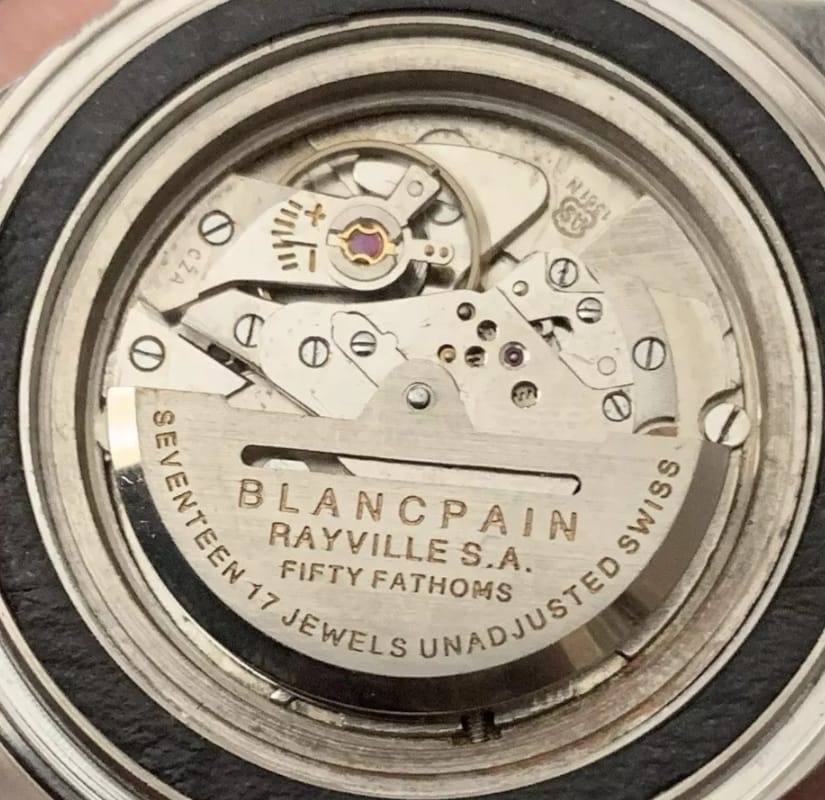
    Adolphe Schild 1361N movement from a Blancpain Fifty Fathoms
    The Adolphe Schild 1361N automatic movement, as fitted to a vintage Fifty Fathoms.Photograph: EMore98 · CC BY-SA 4.0 · Wikimedia Commons
    The need
    A diver has to know how long he has been down and how much air is left. A misread watch can kill.
    Asked for by
    Blancpain’s head, Jean-Jacques Fiechter, a diver who had once run out of air, designed it; the first large order came from the French Navy’s combat divers under Robert Maloubier and Claude Riffaud, who had drawn up the same list of demands.
    What was new
    A rotating bezel that has to be pressed down before it turns, so the start of a dive can be marked and not lost; plus automatic winding, a double-sealed crown, a luminous dial and an anti-magnetic inner case.
    Worth knowing
    These features, taken together, are what the international diver’s watch standard later required. The name refers to fifty fathoms, about 91 metres, then thought the limit for a diver.

    Historian’s noteThe 1953 date is Blancpain’s own. Its bezel patent was filed in 1954, while Rolex filed Submariner patents in early 1953. First to market is unresolved; first designed around timing a dive is Blancpain’s stronger claim.

    SourcesBlancpain

  • The first automatic chronometer with date

    The need
    An everyday watch that showed the date at a glance and could be trusted to keep time.
    Made by
    Rolex, for its fortieth anniversary. Reference 4467.
    What was new
    Not the date window itself but the combination: the sealed Oyster case, the self-winding rotor, a certified chronometer rate and a date at three o’clock, in one watch.
    Worth knowing
    It came on a new bracelet later named the Jubilee. The date moved over slowly around midnight; the instant change arrived about ten years later. The model has been in production ever since.

    Historian’s noteNot the first wristwatch with a date: Movado showed one around 1915 and a date window at three was in use by the early 1930s.

    SourcesRolex

  • The first perpetual chronograph

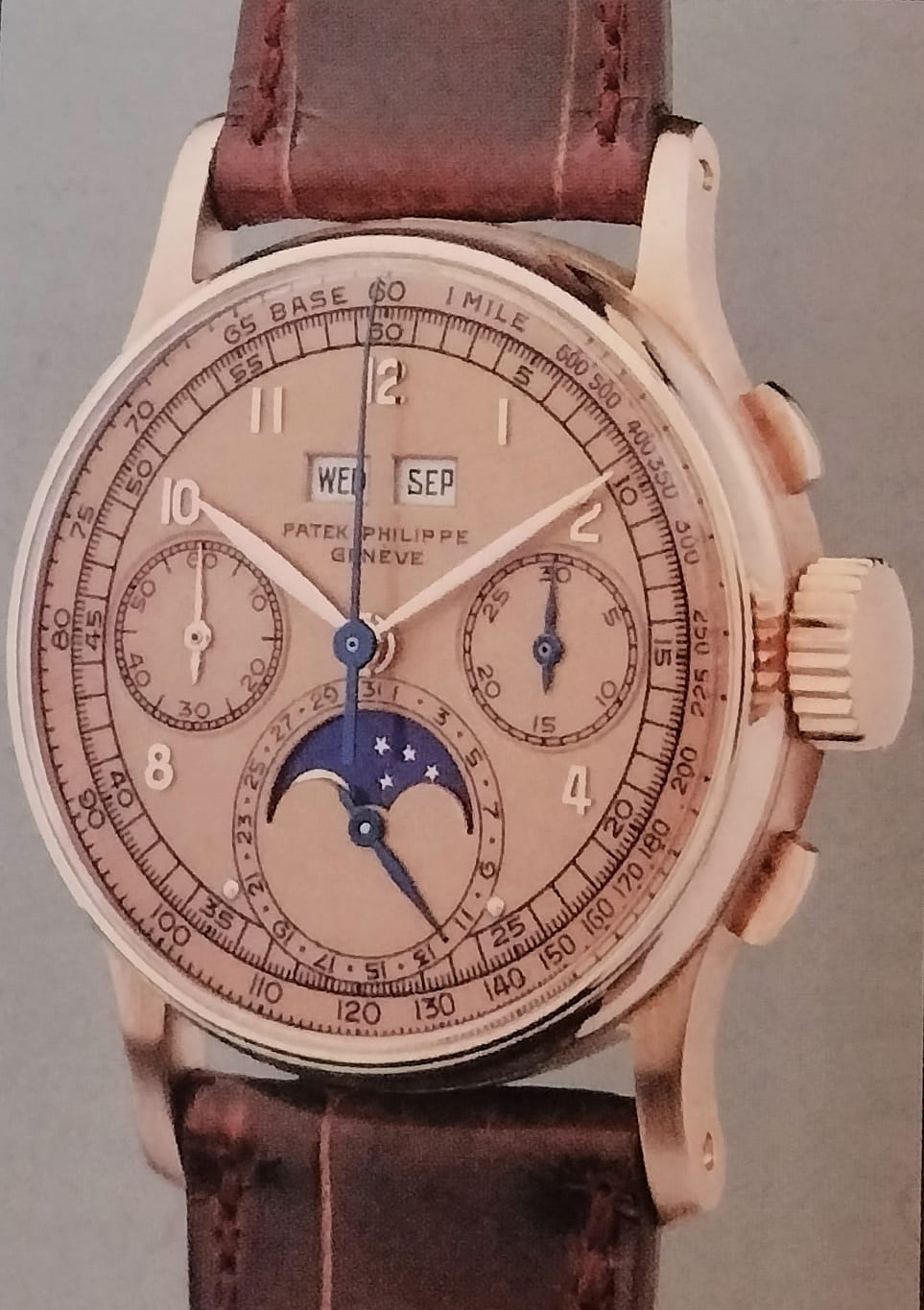
    Patek Philippe reference 1518 perpetual calendar chronograph
    A Patek Philippe reference 1518 of the mid-1940s — the reference itself.Photograph: Clyde94 · CC BY-SA 4.0 · Wikimedia Commons
    The need
    Both complications had reached the wrist separately; no one sold a watch combining them.
    Made by
    Patek Philippe, on a Valjoux chronograph base with a perpetual calendar mechanism by Victorin Piguet.
    What was new
    A chronograph and a perpetual calendar together in a 35 mm catalogue watch.
    Worth knowing
    281 were made between 1941 and 1954, mostly in yellow gold and only four in steel. One of the steel examples sold at Phillips in Geneva in 2016 for 11 million Swiss francs. Every Patek Philippe perpetual calendar chronograph since follows its layout.

    SourcesPhillips · Sotheby’s

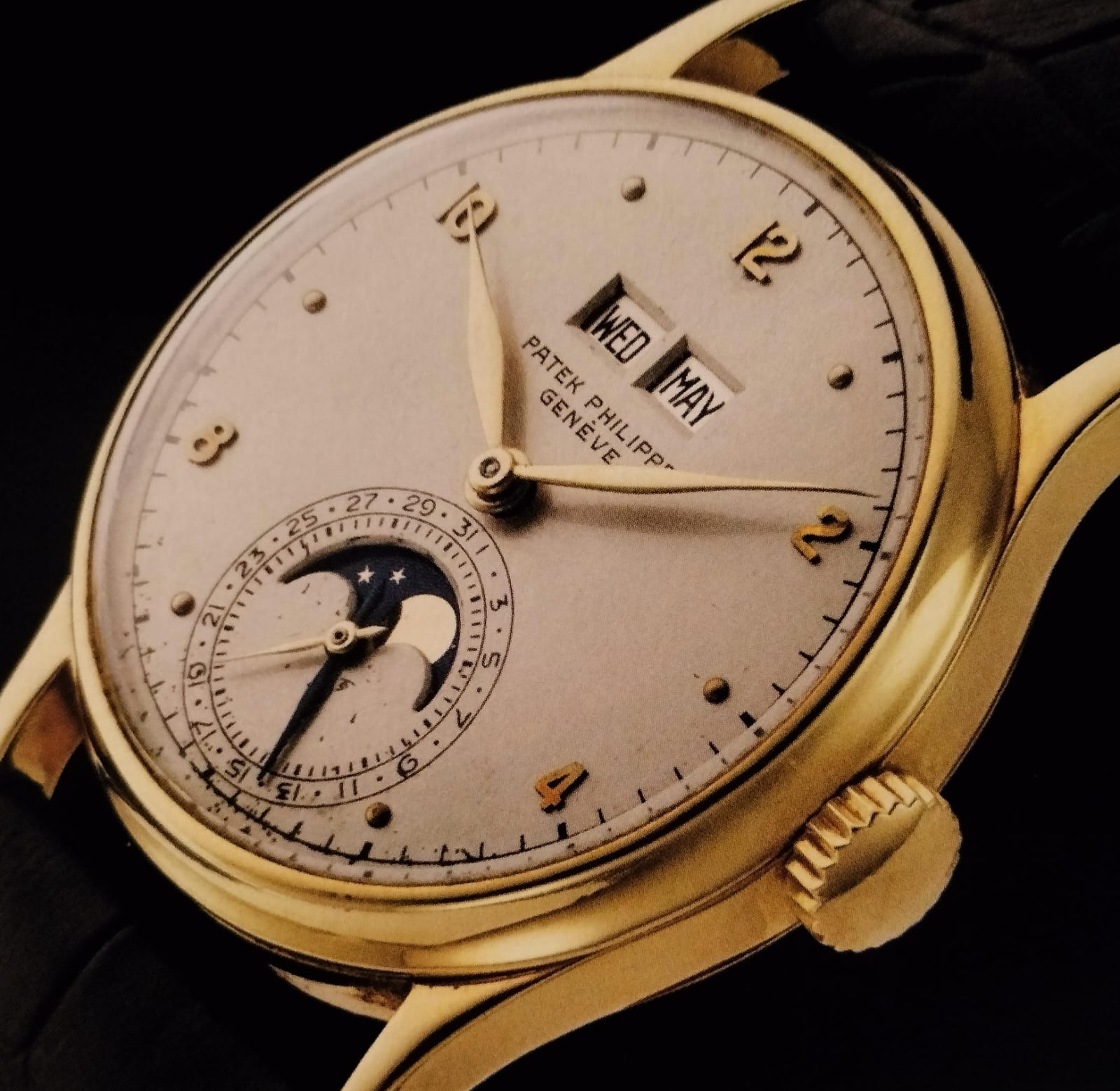
  • The first serial perpetual calendar

    Patek Philippe reference 1526 perpetual calendar wristwatch
    A Patek Philippe reference 1526 of the mid-1940s, the reference itself.Photograph: EMore98 · CC BY-SA 4.0 · Wikimedia Commons
    The need
    Until then a perpetual calendar wristwatch had to be specially ordered.
    Made by
    Patek Philippe, with a movement based on a Victorin Piguet calibre.
    What was new
    A perpetual calendar in a catalogue model: day and month in two windows below twelve, date and moon phase in a dial at six, the layout Patek Philippe still uses.
    Worth knowing
    About 210 were made up to the early 1950s, nearly all in yellow gold.

    Historian’s noteSome timelines give 1942, which usually refers to a particular watch rather than the launch.

    SourcesSotheby’s · Phillips