Archives: Milestones

  • The first split-seconds wristwatch

    The need
    A normal chronograph times one thing at a time. A split-seconds chronograph has a second hand that can be stopped to read an intermediate time, a lap or a second runner, while the main hand keeps running.
    Made by
    Patek Philippe. The movement was begun in about 1903, probably by the specialist Victorin Piguet, and was cased and sold as a wristwatch on 13 October 1923.
    What was new
    The split-seconds function on the wrist: two chronograph hands, one on top of the other, split apart by a pusher and rejoined by pressing it again.
    Worth knowing
    The mechanism itself was a century old in pocket watches; Joseph Thaddäus Winnerl built the first two-hand split-seconds in Paris in the 1830s. This watch sold at Sotheby’s in New York in 2014 for 2,965,000 dollars.
    Where it is now
    The Patek Philippe Museum, Geneva, which bought it at that sale.

    Historian’s noteThe claim, as the auction catalogue put it, is the earliest known split-seconds chronograph wristwatch, by any maker. No earlier one has come to light. It is not to be confused with A. Lange & Söhne’s Double Split of 2004, the first with a split minute counter as well.

    SourcesSotheby’s · Patek Philippe
  • The first tourbillon

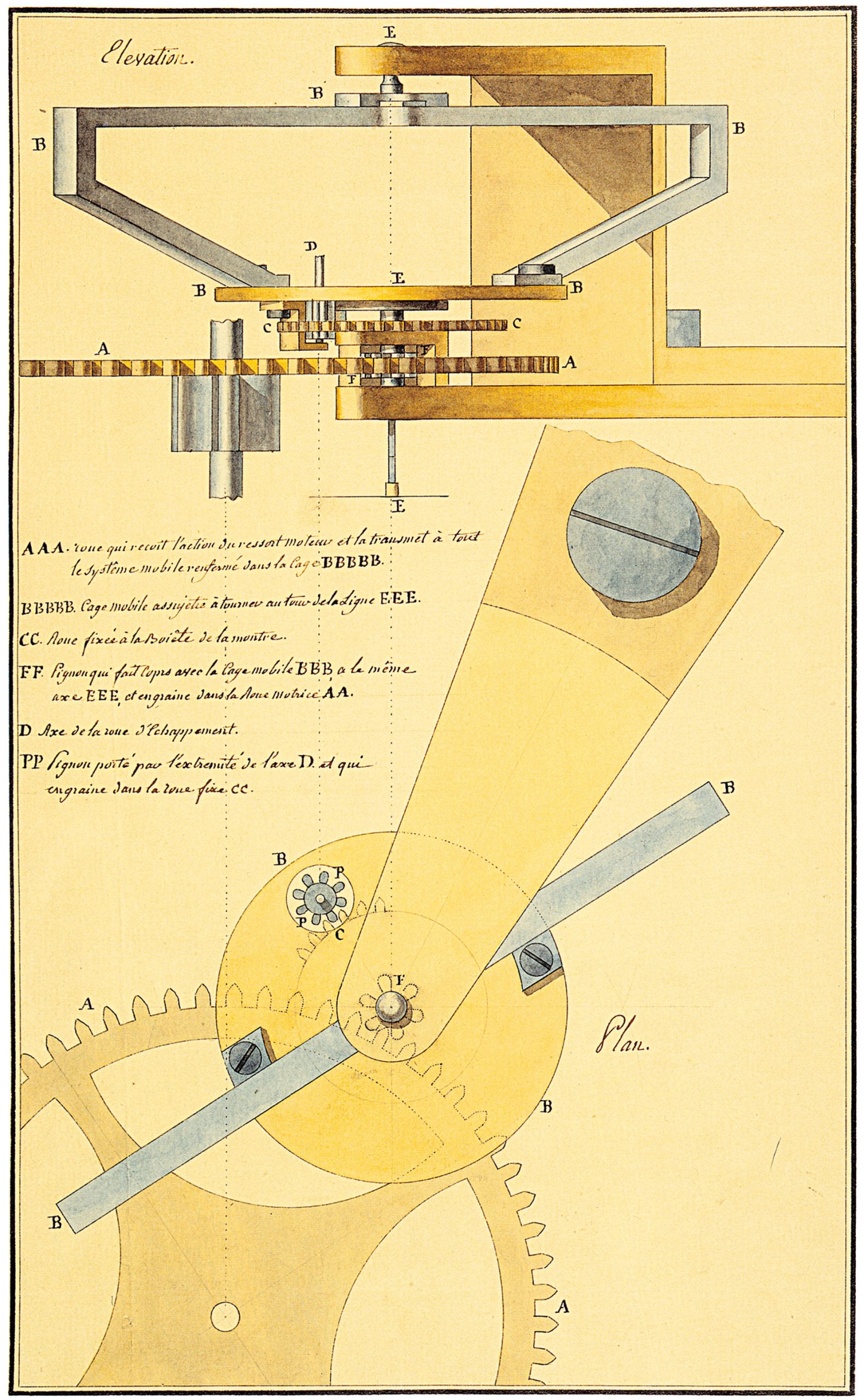
    Breguet’s original drawing for the tourbillon patent, 1801
    Breguet’s own drawing for the 1801 patent application. Institut National de la Propriété Industrielle, Paris.Drawing: Abraham-Louis Breguet · Public domain · Wikimedia Commons
    The need
    A pocket watch spends the day upright in a pocket. Gravity pulls the balance slightly off centre, and the watch runs at a different rate in each position.
    Made by
    Abraham-Louis Breguet, the Swiss-born watchmaker working in Paris. Patent granted on 26 June 1801, 7 Messidor Year IX in the revolutionary calendar, for ten years.
    What was new
    The balance and escapement are mounted in a cage that turns once a minute, so the positional errors cancel each other out over each turn.
    Worth knowing
    Breguet sold the first tourbillon watches in 1805 and made about thirty-five before his death in 1823. In a pocket watch, which hangs in one position all day, the idea made sense. On a wrist, which changes position constantly, the benefit is debated, and today the tourbillon is mainly a showpiece of fine watchmaking.
    Where it is now
    The patent drawing is kept by the French patent office in Paris. A few of Breguet’s tourbillon watches survive in museums and private collections.

    SourcesBreguet

  • The first self-winding watch

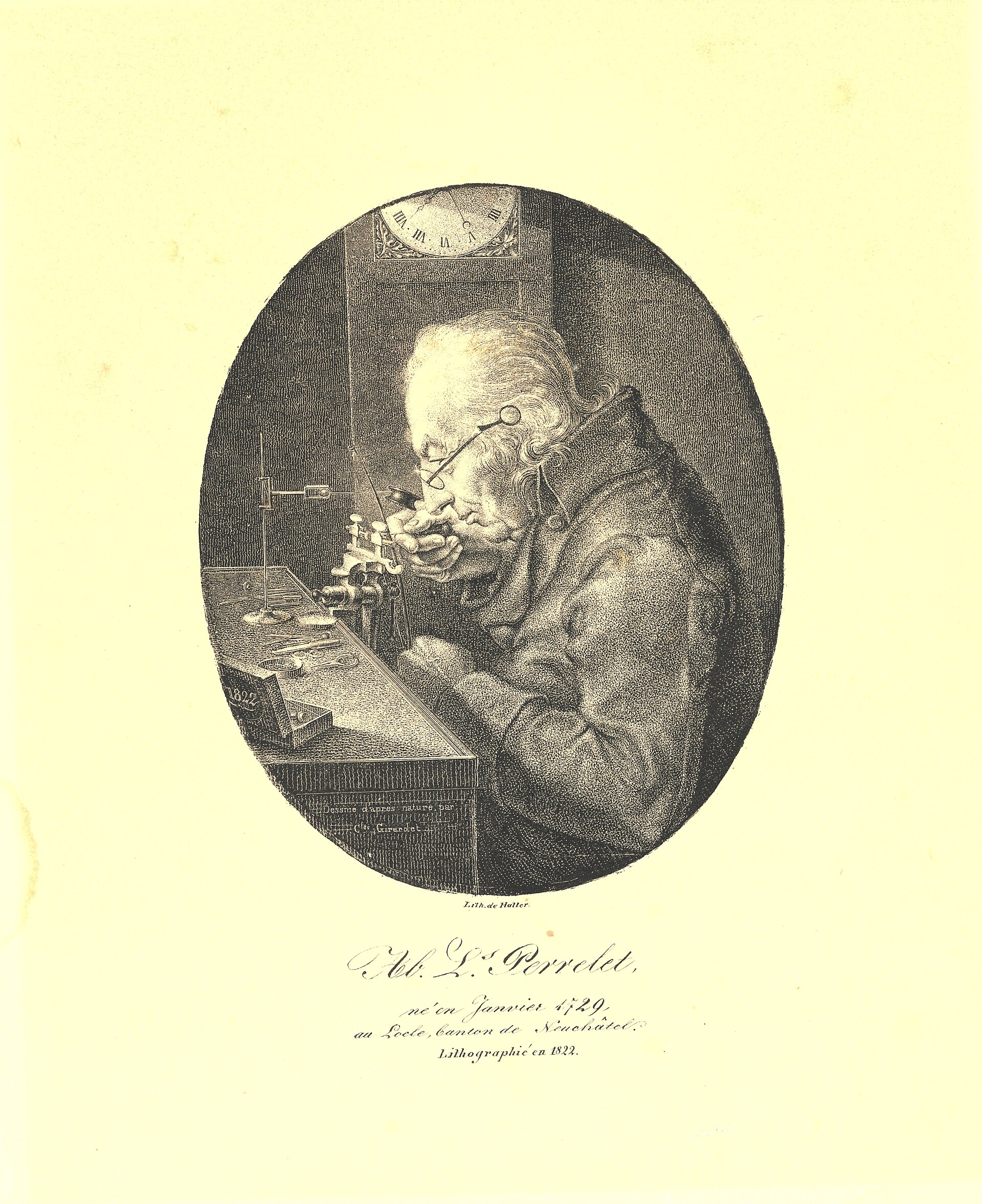
    Lithograph portrait of Abraham-Louis Perrelet
    Abraham-Louis Perrelet (1729–1826), from a lithograph of 1822. No watch that can be firmly attributed to him is known, so the man stands in for the object.Lithograph after Charles-Samuel Girardet · Public domain · Wikimedia Commons
    The need
    A watch had to be wound every day with a key, and a forgotten winding meant a stopped watch.
    Made by
    Abraham-Louis Perrelet, a watchmaker of Le Locle in the Swiss Jura.
    What was new
    A swinging weight inside the watch that moved with the wearer’s steps and wound the mainspring as he walked.
    Worth knowing
    The Geneva Society of Arts reported that fifteen minutes of walking wound the watch for eight days. The principle only worked in a pocket, carried by someone on foot. Breguet took it up from about 1780 in his perpétuelles, and it returned in the wristwatch in 1923.
    Where it is now
    No watch firmly attributed to Perrelet survives.

    Historian’s noteThe evidence for Perrelet is second-hand: a 1777 note by the naturalist Horace-Bénédict de Saussure naming him as the inventor. Hubert Sarton presented a self-winding design with a central weight to the Paris Academy of Sciences in December 1778, with drawings that survive, and Louis Recordon patented a self-winding watch in London in 1780. Some researchers credit Sarton. The modern Perrelet brand has no descent from him.

    SourcesPerrelet

  • The first balance spring

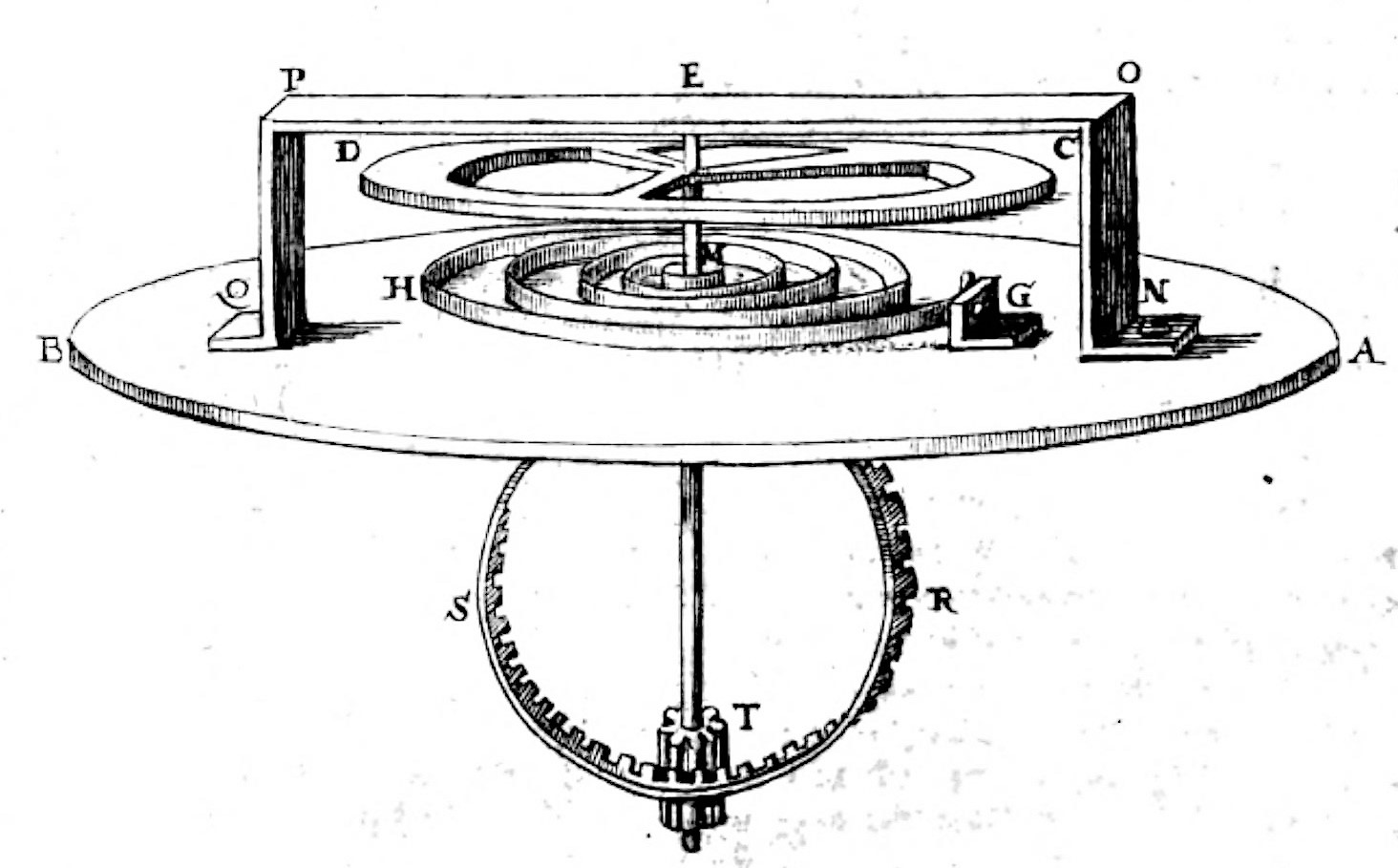
    Engraving of an early spiral balance spring fitted to a balance wheel
    An engraving of 1676 showing one of Huygens’s first spiral springs fitted to a balance wheel.Engraving: Johann Christoph Sturm · CC BY-SA 4.0 · Wikimedia Commons
    The need
    A watch balance of the time had no rhythm of its own; it simply swung as hard as the mainspring pushed it. Watches could drift by a quarter of an hour or more in a day and were rarely trusted to the minute.
    Made by
    Christiaan Huygens, the Dutch mathematician then working in Paris. The first watch to his design was built by the Paris clockmaker Isaac Thuret.
    What was new
    A fine spiral spring attached to the balance. The spring gives the balance a natural period of its own, as a pendulum does for a clock, so it beats at a steady rate whatever the mainspring is doing.
    Worth knowing
    Huygens worked the idea out on 20 January 1675 and sent it to the Royal Society in London as a coded anagram, to prove his priority without giving the idea away. Watches soon gained a minute hand, because they were finally accurate enough to need one. Every mechanical watch made since uses a balance spring.
    Where it is now
    No Thuret watch of 1675 is known. One of the earliest surviving balance-spring watches, by Thomas Tompion of London, made between 1675 and 1679, is in the Science Museum, London.

    Historian’s noteRobert Hooke claimed he had thought of a spring-controlled balance first, and the dispute was never settled. The fairest reading is that Hooke had the general idea and Huygens the working spiral. Thuret also briefly presented the watch as his own invention before apologising.

    SourcesScience Museum · Seiko Museum Ginza

  • The first digital watch

    The need
    None anyone had asked for. It showed that a watch could be pure electronics.
    Made by
    Hamilton, sold under the Pulsar name.
    What was new
    A quartz crystal, an integrated circuit and light-emitting diodes forming the digits directly.
    Worth knowing
    The display drew so much current that it stayed dark until a button was pressed. It went on sale in spring 1972 at 2,100 dollars in an 18-carat gold case. Within a few years liquid-crystal displays, which can stay on, had replaced LEDs.

    Historian’s noteAnnounced in 1970, sold from 1972. The 1970 date is often quoted alone, which is misleading.

    SourcesHamilton · Smithsonian

  • The first tuning-fork watch

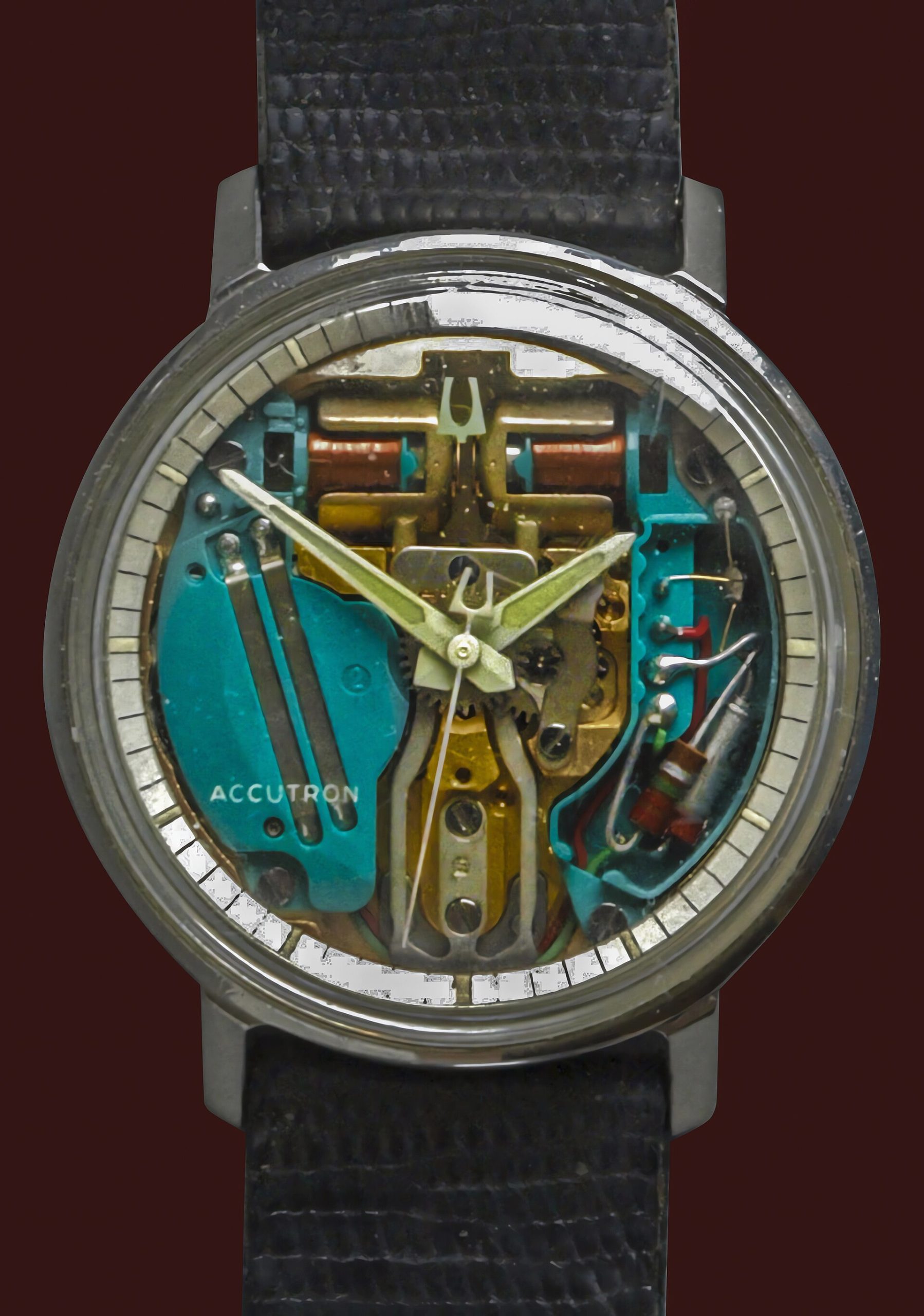
    Bulova Accutron Spaceview showing the tuning fork movement
    A Bulova Accutron Spaceview of 1971, its dial cut away to show the tuning fork. A later example than the 1960 launch.Photograph: Tmtriumph · Public domain · Wikimedia Commons
    The need
    A balance wheel runs at different rates in different positions and temperatures, and after shocks.
    Made by
    Max Hetzel, a Swiss engineer, for Bulova of New York. Launched on 25 October 1960.
    What was new
    A tuning fork vibrating 360 times a second, kept going by a transistor circuit. The seconds hand swept smoothly, and the watch hummed.
    Worth knowing
    It was accurate to a minute a month, better than any mechanical wristwatch of its time, and it was the first wristwatch certified by NASA for use in spaceflight instruments. It is the direct step between the mechanical watch and quartz.

    SourcesBulova · Google Patents, US 2,949,727

  • The first electric wristwatch

    The need
    A mainspring must be wound and gives uneven power as it runs down.
    Made by
    Hamilton Watch Company of Lancaster, Pennsylvania. Presented in New York on 3 January 1957.
    What was new
    A button cell instead of a mainspring. The balance wheel stayed; a coil on it, switched by tiny contacts, kept it swinging.
    Worth knowing
    Without a mainspring the case could take shapes no ordinary movement allowed, such as Richard Arbib’s triangular Ventura. The contacts wore out, and the calibre gained a reputation for unreliability.

    Historian’s noteElgin announced a battery watch in 1952 but sold one only in 1961. The Hamilton is first to market, not first to a working design.

    SourcesHamilton · Smithsonian

  • The first audible alarm watch

    The need
    Alarm wristwatches had existed since 1914, but the sound of a hammer striking a small case against a sleeve was too faint to be useful.
    Made by
    Vulcain of La Chaux-de-Fonds. It went on sale in the United States late in 1947.
    What was new
    A double caseback with an air gap between the layers. The hammer strikes a thin membrane that resonates like a sounding board.
    Worth knowing
    Named for the chirping sound. Several American presidents wore one, Harry Truman among them, which is how it became known as the President’s watch.

    Historian’s noteNot the first alarm wristwatch: Eterna’s calibre 68 of May 1914 holds that. The Cricket’s first is being audible.

    SourcesVulcain

  • The first world time wristwatch

    The need
    Telegraph, liners and aircraft meant people needed to know the hour somewhere else. Working it out in the head is exactly where mistakes happen.
    Made by
    The watchmaker Louis Cottier of Carouge, near Geneva, who devised the system around 1931. Patek Philippe used it in the references 515 HU and 96 HU.
    What was new
    A 24-hour ring geared to the hour hand, turning inside a fixed ring of city names, so the hour in every zone can be read at a glance.
    Worth knowing
    Cottier’s first watches on the principle were pocket watches; Vacheron Constantin ordered one in 1932. In 1953 he added a second crown for turning the city ring, the form the complication still takes.

    Historian’s noteThe invention is Cottier’s, not Patek Philippe’s. 1937 is the date of the first world time wristwatch. Patek Philippe’s own records date Cottier’s first world time movement for the firm to 1937, in the pocket watch reference 605 HU; its early world time wristwatches followed within a few years. 1937 is best read as the year the complication reached Patek Philippe.

    SourcesPatek Philippe Magazine · Fondation de la Haute Horlogerie

  • The first diving watch

    The need
    Divers needed a watch that could go under water, not merely survive rain or a splash.
    Made by
    Omega, of Biel.
    What was new
    A case within a case: the watch slides into an outer shell that is clamped shut over a cork seal, so water pressure presses the closure tighter the deeper it goes.
    Worth knowing
    Omega tested it to 73 metres in Lake Geneva and later to 135 metres in the laboratory. It had no rotating bezel for timing a dive; that came twenty years later.

    Historian’s noteThe depth figures come from Omega’s own tests. Water-resistant cases existed before it; the claim is the first watch made and sold for diving.

    SourcesOmega