
- The need
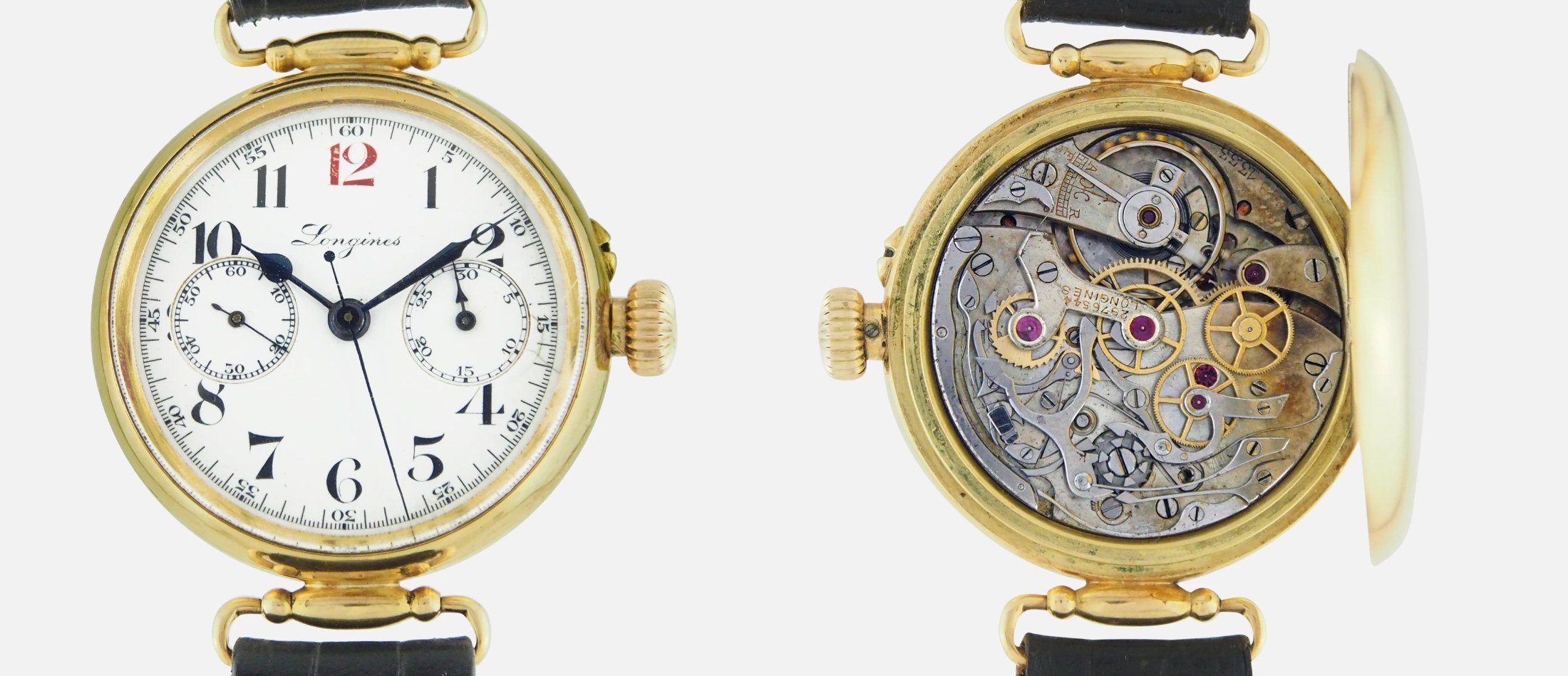
- A pocket chronograph has to be held in the hand to be used. Anyone timing something with their hands busy, a driver, a pilot, a doctor taking a pulse, needed one on the wrist.
- Made for
- The earliest known example, dated by the Longines archive to 29 November 1913, was delivered to the firm’s agent for Russia.
- What was new
- A 29 mm chronograph calibre that fitted a wrist case, with a centre chronograph seconds hand and a jumping thirty-minute counter at three o’clock.
- Worth knowing
- One push-piece in the crown did everything, always in the same order: start, stop, return to zero. The watch looked like an ordinary wristwatch. The movement was not designed from nothing: Longines took its time-only calibre 13.33 of 1910 and built a column-wheel chronograph mechanism onto it, which was how chronographs were made at the time. Later versions moved the pusher to two o’clock, and around 1925 a few gained a flyback.
- Where it is now
- The earliest pieces are in private collections. The Longines Museum in Saint-Imier holds later examples of the calibre.
Historian’s noteNot the first chronograph worn on the wrist. Longines itself shows a wrist chronograph of 1911 built around its pocket calibre 19.73N, and Omega and Moeris had small chronographs on the wrist at about the same time. The claim that holds is one of the first chronograph calibres made at wristwatch size. Pictures captioned as the 1913 watch are often Longines’ 2014 re-edition: 40 mm, self-winding, with a date at six. The originals are about 35 mm, hand-wound and have no date.
SourcesLongines