Timeline / The first quartz wristwatch
The first quartz wristwatch
First
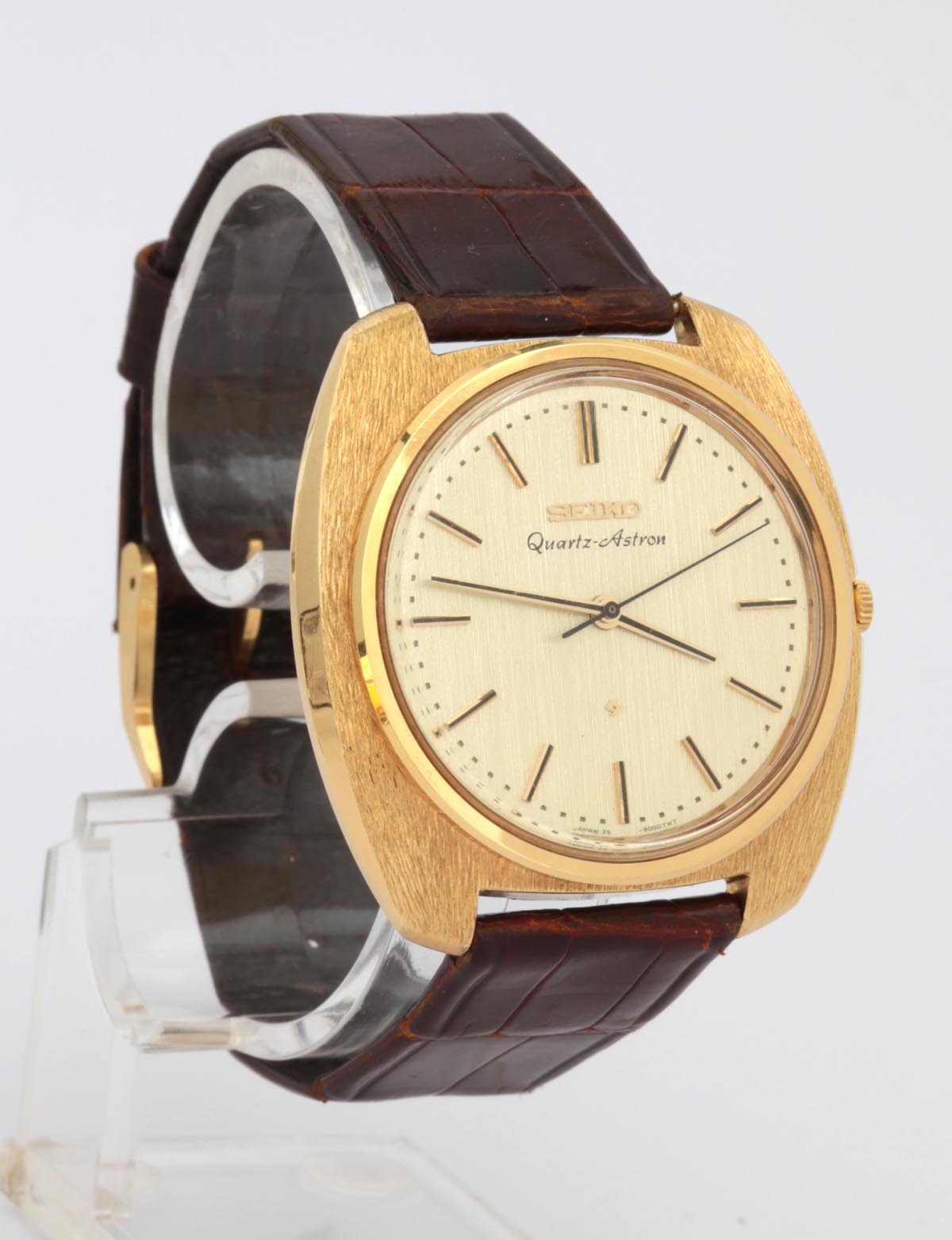
Seiko sold the first quartz wristwatch, the Quartz Astron, in Tokyo on 25 December 1969.

- The need
- Accuracy far beyond anything a balance wheel could deliver.
- Made by
- Suwa Seikosha, part of Seiko.
- What was new
- A quartz crystal vibrating 8,192 times a second, divided down by a circuit to drive a stepping motor. Seiko quoted about five seconds a month.
- Worth knowing
- One hundred were made, in 18-carat gold, at 450,000 yen, about the price of a medium-sized car. Within fifteen years quartz had taken over the watch industry.
- Where it is now
- The example shown is in the Deutsches Uhrenmuseum, Furtwangen.
- What it set off
- Quartz spread faster than any change in the history of the watch. Within a decade it was cheaper than a mechanical movement, and the Swiss industry, which had half the world market in 1970, lost most of the low and middle end to Japan and Hong Kong. Swiss watch employment fell from about 90,000 in 1970 to 28,000 in 1988, and the number of Swiss firms from about 1,600 to 600 by 1983. Whole companies and calibres disappeared. The turn came with the Swatch of 1983, and the mechanical watch survived only by becoming a luxury.
Historian’s noteFirst sold, not first built: Swiss prototypes ran in 1967, and Longines announced a quartz watch in August 1969 that did not ship until later.
SourcesIEEE Milestone · Seiko Museum Ginza
Suggest a correction