Timekeeping / The bookkeeper’s year
The bookkeeper’s year
Uruk bookkeepers reckoned every month as 30 days and the year as 360.
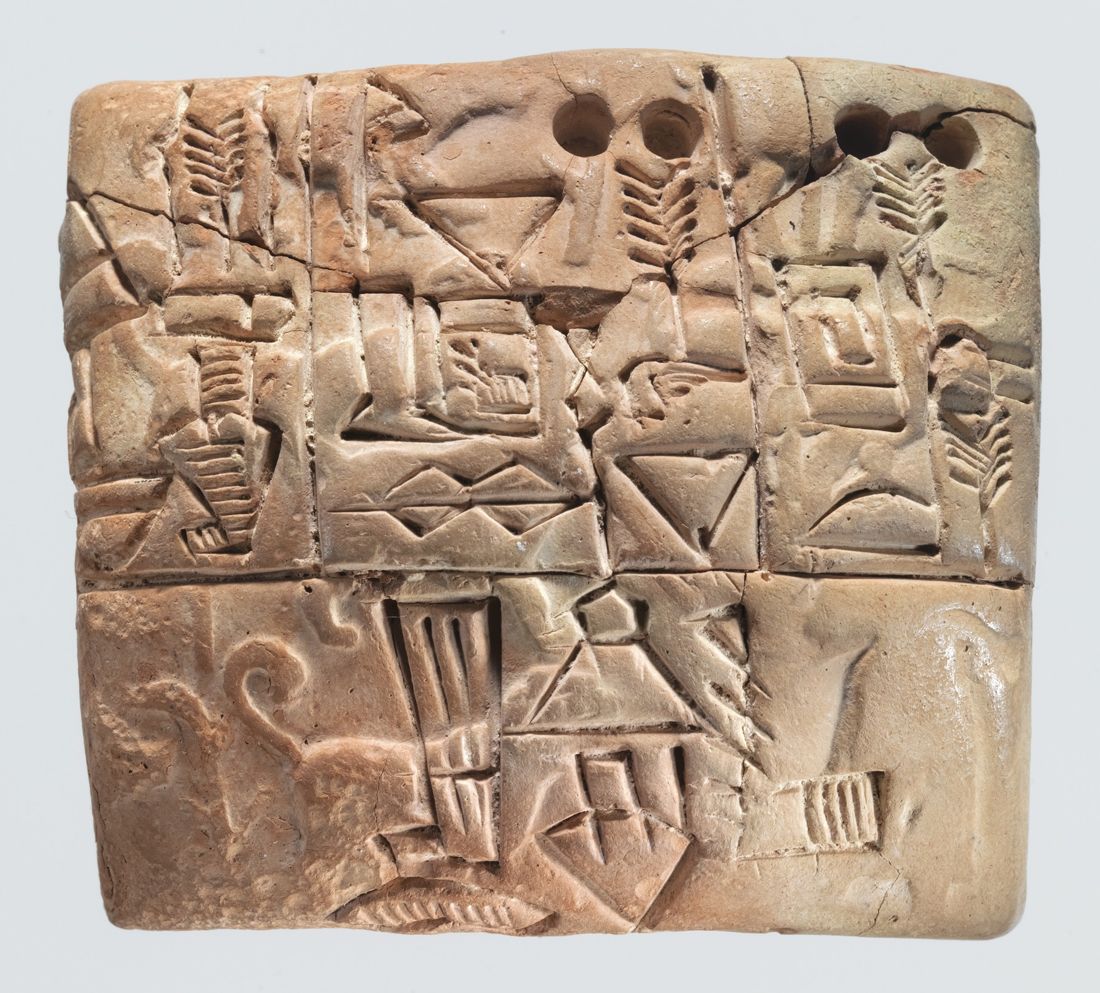
- The need
- Uruk, in the south of what is now Iraq, was the first city of the Sumerians. Writing was invented there, in the late fourth millennium BC, to keep the accounts of temple estates: rations of barley and beer, herds, labour. Those accounts had to say for how long a ration ran.
- How it worked
- Scribes wrote a sun sign for “day” and added number strokes for days and months. A ration for one month was always thirty daily rations, whatever the moon did, so the bookkeepers’ month was 30 days and their year 12 × 30 = 360 days. Beside it ran the real calendar of lunar months, 29 or 30 days long, with a thirteenth month slipped in every few years to keep the seasons in step.
- What it changed
- The 30-day administrative month was still in use a thousand years later under the kings of Ur, and it became the “ideal year” of Babylonian astronomy. Dividing the year into convenient equal parts, rather than following the moon, is the first step towards measuring time.
- Where it is now
- The tablet shown is in the Metropolitan Museum of Art, New York. The clearest tablets with day and month signs come from Jemdet Nasr and are in Baghdad and Oxford.
SourcesEnglund, “Administrative Timekeeping in Ancient Mesopotamia”, JESHO 31 (1988) · Brack-Bernsen, “The 360-Day Year in Mesopotamia” (2007) · The Met, 1988.433.1 · CDLI P005393