
Timeline / The first repeating watch
The first repeating watch
Invention
In 1687 Edward Barlow and Daniel Quare each put a watch before James II that could strike the hours and quarters on demand; the King preferred Quare’s, and the repeating watch was born.
- The need
- Before matches and electric light, a watch could not be read at night without lighting a candle. A watch that could sound the time on demand solved that.
- Made by
- Daniel Quare of London, and at the same time Edward Barlow, whose watch was built by Thomas Tompion. Both were tried before James II and his Council in 1687; the King preferred Quare’s.
- What was new
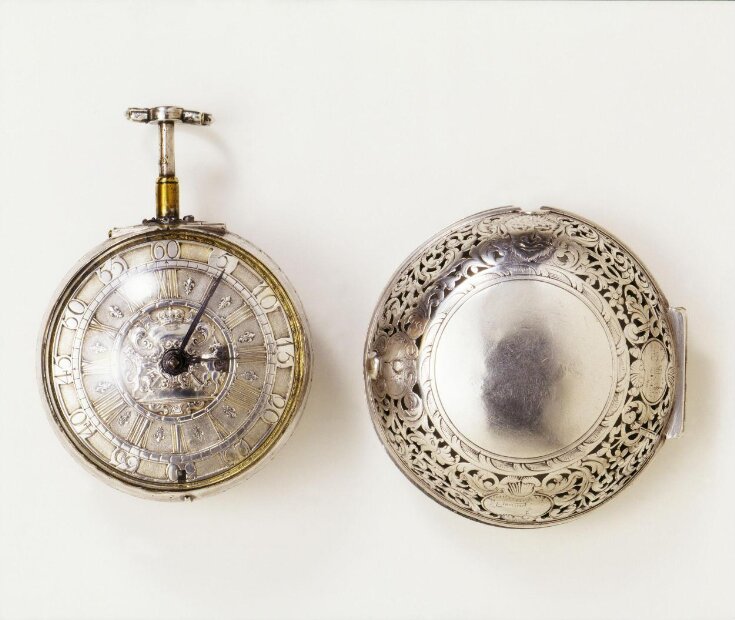
- A watch that struck the last hour and quarter on a bell inside the case when a pin by the pendant was pressed. Barlow’s needed two pushers, one for the hours and one for the quarters; Quare’s did both with one.
- Worth knowing
- William Derham, writing in 1696 while the makers were still alive, is the source for the trial before the King. Barlow had applied for a patent and lost it. These were quarter repeaters: the minute repeater came a generation later, and nobody knows for certain who made the first.
- Where it is now
- No watch from the 1687 trial is identified. A Quare quarter repeater of about 1700 is in the Victoria and Albert Museum, London.
Historian’s noteModern accounts differ on whether Quare was granted a patent or Barlow was simply refused one. Derham says only that the King gave Quare’s watch the preference, and that is as far as the record goes.
SourcesVictoria and Albert Museum · Derham, The Artificial Clock-maker (1696) · Antiquarian Horological Society
Suggest a correction