Timeline / The earliest perpetual calendar and day-date watch
The earliest perpetual calendar and day-date watch
First
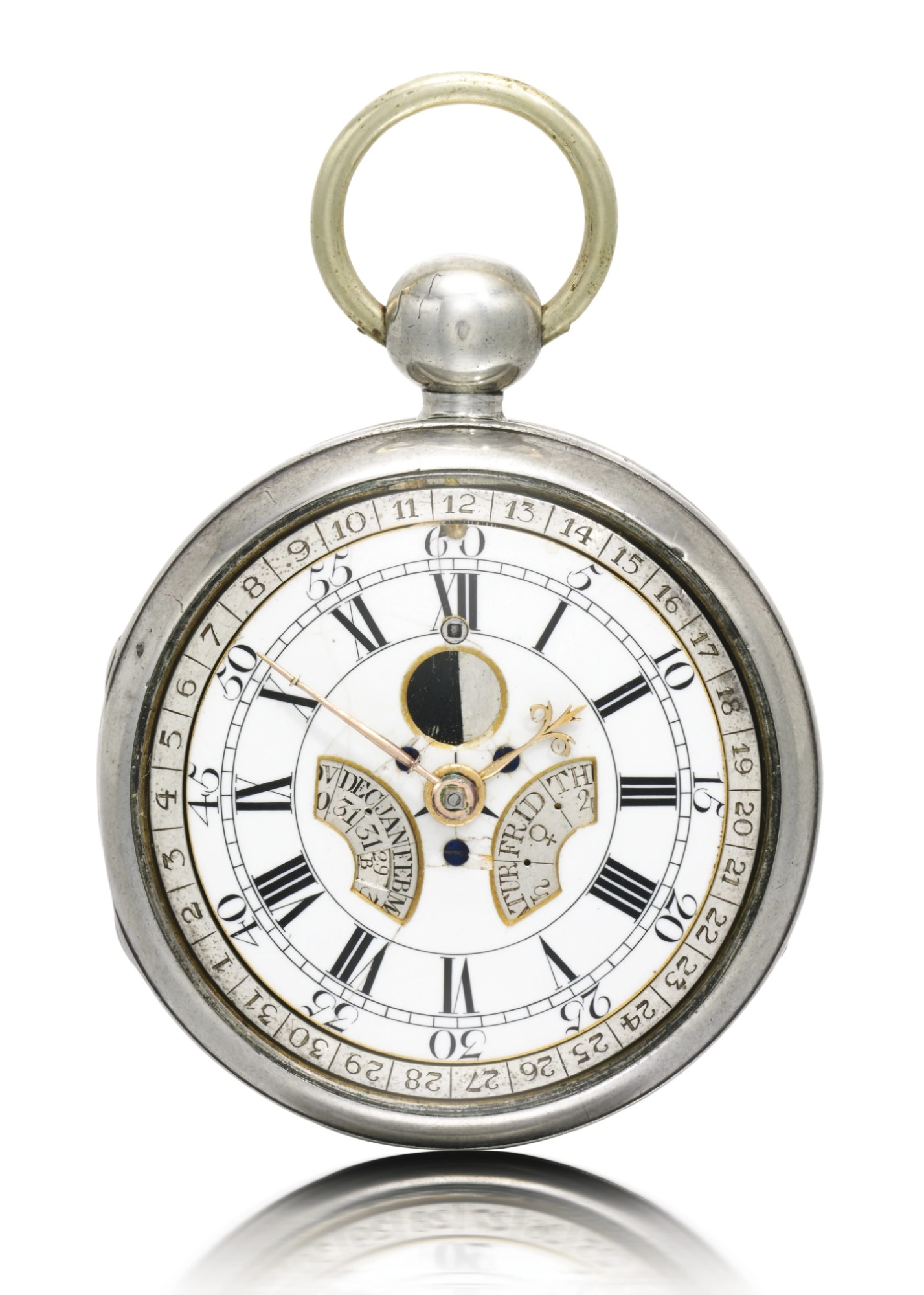
About 1762 Thomas Mudge in London made a watch whose calendar knew the length of every month and the leap year, and showed the day of the week beside the date: the earliest perpetual calendar watch known with certainty.
- The need
- A calendar watch counts to 31 and has to be set forward by hand at the end of every shorter month, and again for February. A perpetual calendar does that by itself, leap years included.
- Made by
- Thomas Mudge, watchmaker in London, who also built the lever escapement (1770).
- What was new
- A white enamel dial with an outer date ring and pointer, an aperture for the months with a small extra window for February that shows the leap year, an aperture for the day of the week and a moon-phase aperture. Behind it, a gilt full-plate movement with fusee and chain and a ruby cylinder escapement, signed Tho. Mudge, London and numbered 525.
- Worth knowing
- Breguet was long thought to have made the first perpetual calendar watch. The perpetual calendar reached the wrist only in 1925.
- Where it is now
- Offered by Sotheby’s in London in 2016 (lot 28); the present owner is not published.
Historian’s noteSotheby’s calls it “possibly the earliest perpetual calendar watch”. No complete perpetual calendar watch is known with certainty to be older. The date 1762 is George Daniels’s, from the movement. The silver case is later.
SourcesSotheby’s, Celebration of the English Watch Part II, lot 28
Suggest a correction